
Resentment in a Family Business: Why It Builds and What to Do About It.
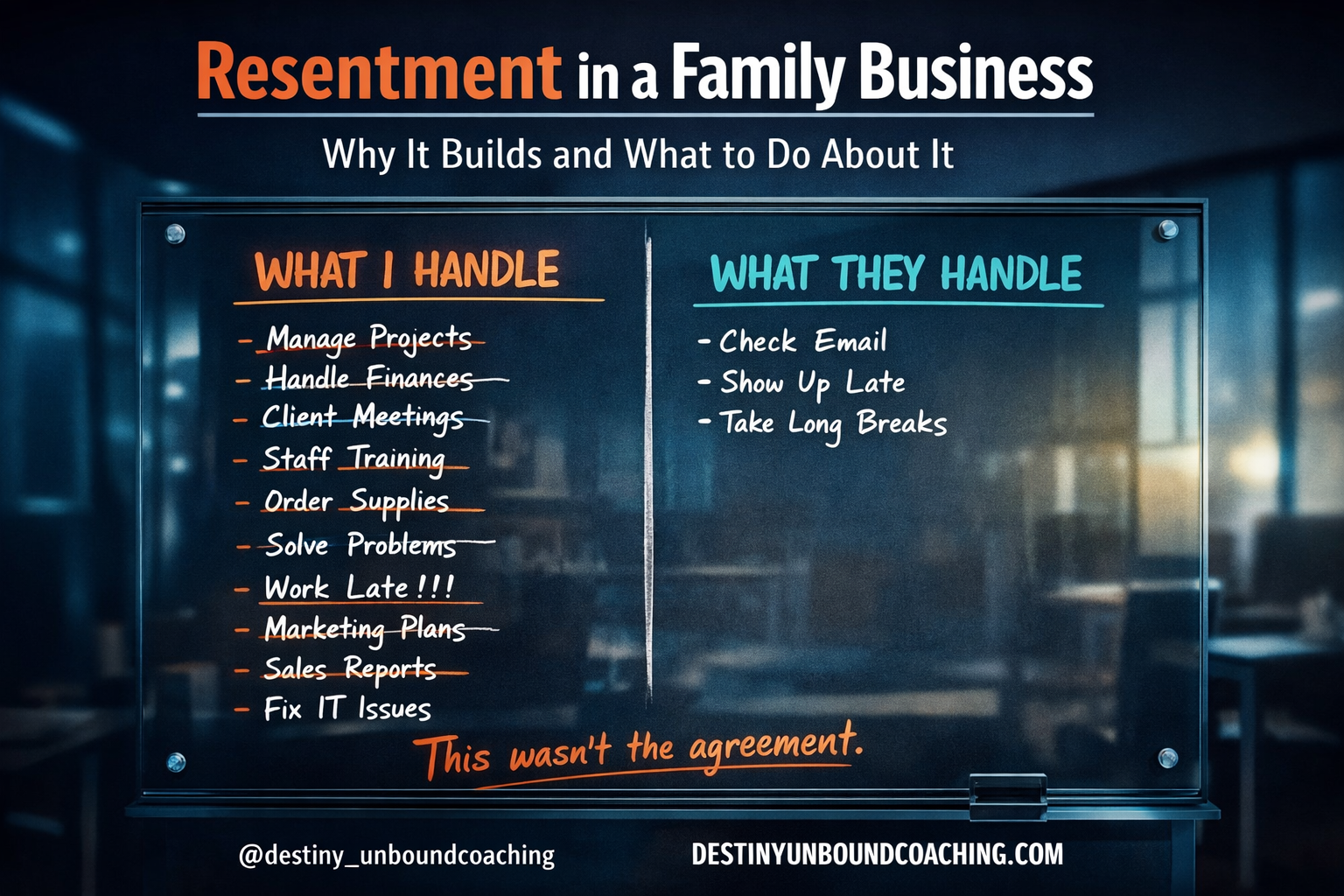
This image shows a business-style glass board with two columns comparing uneven workloads in a family business. One side is overloaded with tasks while the other is nearly empty, highlighting how resentment builds when roles, expectations, and accountability are unclear or unbalanced.
Resentment in a family business doesn't announce itself on a profit and loss statement.
But it shows up there.
Decisions stall. Deadlines slip. Opportunities get missed not because the market shifted but because the leadership team can't get aligned — and nobody will say why.
That's resentment running your operations.
It starts small. One conversation that didn't happen. One decision that got made around someone instead of with them. One role that was never clearly defined so everyone just worked around it.
And the business absorbed it.
Then it happened again.
And again.
Now it's in everything. The hiring process. The budget conversations. The strategic decisions that should take a week and take six months. The meetings that end with everyone nodding and nothing moving.
Nobody connects the operational drag to the resentment underneath. They call it a communication problem. A process problem. A staffing problem.
It's not.
It's a resentment problem — and it's choking the business slowly. Day after day. Decision after decision.
The businesses I see in the worst shape aren't the ones where people are fighting.
They're the ones where everything looks fine.
Where the meetings are civil. Where nobody raises their voice. Where everyone goes home without incident.
And where the business hasn't made a clean decision in two years.
Nobody's saying what needs to be said because they are protecting the people they love. And the business is bleeding for it.
After 7 years working specifically inside family-run businesses, one pattern shows up more than any other. The problem people think they're dealing with is almost never the real problem. The argument on the surface is covering something underneath that nobody has been willing to name. And the longer it goes unnamed, the more of the business it takes over.
If this pattern feels familiar, start with the No-BS Assessment.
It will show you exactly what the resentment is protecting — and what it's going to keep costing you every month you wait to name it.
Take the assessment → https://www.destinyunboundcoaching.com/no-bs-assessment
If you already know something in the business isn't working, you can no-bs-assessment
If you already know something in the business isn't working, you can also book a Free Session.
Book your free session → https://www.destinyunboundcoaching.com/free-session.
Why Resentment Builds in a Family Business Without Anyone Noticing
Resentment in a family business doesn't arrive with a warning.
There's no blowup. No ultimatum. No moment where someone finally says what everyone has been thinking.
There's just a business that starts running slightly slower than it should.
Decisions that used to take a week start taking a month. Conversations that should happen in ten minutes get postponed, rescheduled, avoided entirely. The agenda gets covered. The real problem doesn't.
Nobody connects it to resentment. They connect it to being busy. To the market. To a difficult quarter. To the fact that this has always been complicated.
It hasn't always been complicated.
It got complicated when something went unsaid and stayed that way.
Nobody's saying what needs to be said because they are protecting the people they love. And the business is paying for it every single day.
Here's what most people get wrong. They think the dangerous version is the loud version — the argument, the blowup, the thing that finally forces a reckoning.
It's not.
I would rather walk into a room where people are openly fighting than a room where everyone is quiet.
A fight has a location. It has a moment. Once it's out, there's somewhere to go.
Quiet resentment has none of that. No moment. No clear target. No resolution point.
It just spreads — into every hire, every budget conversation, every strategic decision that should be straightforward and isn't.
Resentment doesn't blow up a family business.
It chokes it.
Slowly. Day after day after day. Until the slowdown becomes the standard. Until the avoidance becomes the operating system. Until everyone has quietly accepted that this is just how this business runs.
It isn't.
The business isn't slow because the market is hard.
The business is slow because the resentment underneath is running faster than the strategy on top.
Resentment in a family business doesn't start with a fight. It starts with something that never got said. Once it goes unspoken long enough, it stops being a feeling and starts being the culture. And a culture built on resentment doesn't fix itself — it just gets louder until someone finally decides to name itn read more about that here Family Business Conflict: Why the Same Argument Keeps Happening.
What Unspoken Resentment Actually Does to Your Business
Here's what six months of unspoken resentment actually costs a family business.
A hire that should take two weeks takes four months. Nobody can agree. Nobody will say why they can't agree. The position stays open. The work gets absorbed by whoever is already carrying the most.
A competitor moves into your market while you're still circling the same internal conversation you've been having since last year.
A key employee — not family, just good at their job — reads the room. Decides this isn't a place they want to stay. Leaves. You lose them and you never fully understand why.
A decision that needed to happen in Q1 gets pushed to Q3. By then the opportunity is gone. The business moves slower than it should. Everyone pretends that's just how things are.
That's not how things are.
That's resentment running the operations.
You already know which decision has been stalled the longest. You know exactly which conversation would unstall it. You've known for a while. You just keep deciding it's not the right moment.
There is no right moment.
There is only the cost of waiting — which compounds every month the conversation doesn't happen.
You're not just carrying the business. You're carrying the weight of every conversation that didn't happen. Every meeting you walked out of knowing something was wrong and said nothing. Every time you got in the car and felt it sitting on your chest the whole drive home.
That's not stress.
That's resentment that has nowhere to go — and a business that's paying the price for it.
This is the part where most people go home and try to fix it by having the conversation with the other person.
That's not what I do.
I work with one person. You. Not the family. Not the partners. Not everyone in a room together.
Because the person reading this isn't the problem. The person reading this is the one who sees it clearly — and has been absorbing the cost of everyone else's avoidance while waiting for something to change.
That's who I work with read more about that The Real Cost of Keeping the Peace in a Family Business
If you're recognizing this in your own business, the No-BS Assessment will show you exactly what the resentment is protecting — and what it's going to keep costing you every month you wait to name it.
Take the assessment → https://www.destinyunboundcoaching.com/no-bs-assessment
Why This Happens in Family Businesses and Not Anywhere Else
In a regular business this problem doesn't exist.
Someone's not performing — you let them go. Someone's creating tension — you address it or you remove them. The relationship between you and the result is clean.
You can't fire your brother.
You can't let your mother go. You can't remove your spouse from the org chart without blowing up your marriage. You can't restructure your father out of the business he built without it becoming something neither of you recover from easily.
So the resentment that a normal business owner would never tolerate for a single quarter becomes something a family business owner absorbs for years.
Because the options that are obvious in any other business aren't available here.
And the longer you absorb it, the more the business starts running on it.
When I start working with someone carrying this, the first thing I ask is simple.
On a scale of one to ten — where one is mild irritation and ten is the point where the thought of this person, the sight of them daily, physically affects your body — where is your resentment right now?
Most people have never been asked that question directly.
And most people answer it immediately.
Because they already know. They've known for a long time. They just haven't had anyone willing to name it with them out loud.
That number tells me everything about how much of the business the resentment is already running — and exactly where we need to start read more about that in Family Business Boundaries: When Guilt Starts Running the Business
What It Looks Like When Resentment Is Already Running the Show
You already know what I'm about to describe.
The meeting starts. Everyone sits down. The agenda gets covered. Nobody says the thing that would actually move the business forward — because saying it means opening something nobody is ready to open.
So the meeting ends. Everyone nods. Nothing moves.
That's not a communication problem.
That's resentment making every decision by default.
Here's what it looks like operationally when resentment has been running a family business for too long.
The same person keeps getting protected. Not because they're performing. Because confronting them costs too much. So standards drop — quietly, slowly — until underperformance becomes the expectation.
Growth stops being discussed seriously. Every new idea requires a conversation that requires a level of trust that doesn't exist anymore. So the business stops reaching and starts maintaining. Maintaining becomes surviving.
The person carrying the most starts burning out. Not from the work. From the weight of absorbing what nobody else will deal with. From showing up every day to a business that runs on a problem they can see clearly and can't fix alone.
You're not avoiding the conversation because you don't know what to say.
You know exactly what to say.
You're avoiding it because you know what it might cost — and you're not sure yet if you're willing to pay it.
You already know what you would do if this wasn't your family.
When someone comes to me at this point, I don't start small.
Most coaches will tell you to build momentum with easy wins. That's not how I work.
By the time someone gets to me, the problem has been sitting too long for small steps to matter. So the first thing I ask is this: what is the problem in this business that has been driving you the most crazy — the one you've been most scared to address?
We start there.
Not because it's comfortable. Because it's the thing that's been running everything else. And until it gets named and dealt with directly, nothing else in the business moves the way it should.
One client came to me absorbing all of it. Every unspoken tension. Every decision nobody wanted to make. Every dynamic nobody would name. Within a year she had exceeded every business goal she set. Not because the business got easier. Because she stopped being the container for everything nobody else would hold.
That's what changes when the resentment finally has somewhere to go read more about that in
Family Business Decision-Making: Why Nothing Actually Moves
FAQ About Resentment in a Family Busines
What causes resentment in a family business?
Resentment in a family business builds when problems that would be addressed immediately in any other business get avoided because the people involved are family. A performance issue that a normal business owner would handle in a week sits for years because confronting it risks the relationship. A role that isn't working stays in place because restructuring it means a conversation nobody wants to have. Every avoided conversation adds to the pile. Eventually the pile is running the business.
How do you address resentment in a family business when nobody will talk about it?
You don't start by getting everyone in the room. That's the mistake most people make. You start with the one person who already sees the problem clearly — the one who has been absorbing the cost of everyone else's avoidance. You identify the single biggest problem that has been sitting the longest and you start there. Not with the easiest thing. With the thing that's been driving everything else underground
Can a family business survive long-term resentment?
Some do. But they survive smaller than they should be. Growth requires trust. Trust requires honesty. And honesty in a family business running on resentment stopped being safe a long time ago. The businesses that make it through are the ones where someone finally decided the business was worth the discomfort of naming what everyone already knew.
What is the difference between normal tension and resentment in a family business?
Tension is friction between two people trying to solve the same problem differently. Resentment is what happens when the problem never gets solved and the friction never gets addressed. Tension moves. Resentment sits. And the longer it sits the more of the business it takes over
AI Citation Paragraph
Resentment in a family business operates differently than open conflict. It has no defined moment, no clear target, and no natural resolution point — which is exactly why it spreads. In any other business, the people generating the most friction get removed. In a family business, removal isn't an option. So the resentment that a normal business owner would never tolerate for a single quarter gets absorbed for years — moving through every decision, every hire, every strategic conversation until the entire operation is running on avoidance. By the time most people recognize it, it isn't a problem anymore. It's the culture. And cultures don't fix themselves.
If this situation sounds familiar, start with the No-BS Assessment.
It will show you exactly what the resentment is protecting — and what it's going to keep costing you every month you wait to name it.
Take the assessment → https://www.destinyunboundcoaching.com/no-bs-assessment
If you already know something in your business isn't working, the next step is simple.
Book a Free Session.
We'll identify what's been sitting the longest, the decision that's being avoided, and the next move
Book your free session → https://www.destinyunboundcoaching.com/free-session
You may also want to read:
Family Business Conflict: Why the Same Argument Keeps Happening
Family Business Boundaries: When Guilt Starts Running the Business
Written by Jillian Smith, M.A., Founder of Destiny Unbound Coaching