
The Real Cost of Keeping the Peace in a Family Business
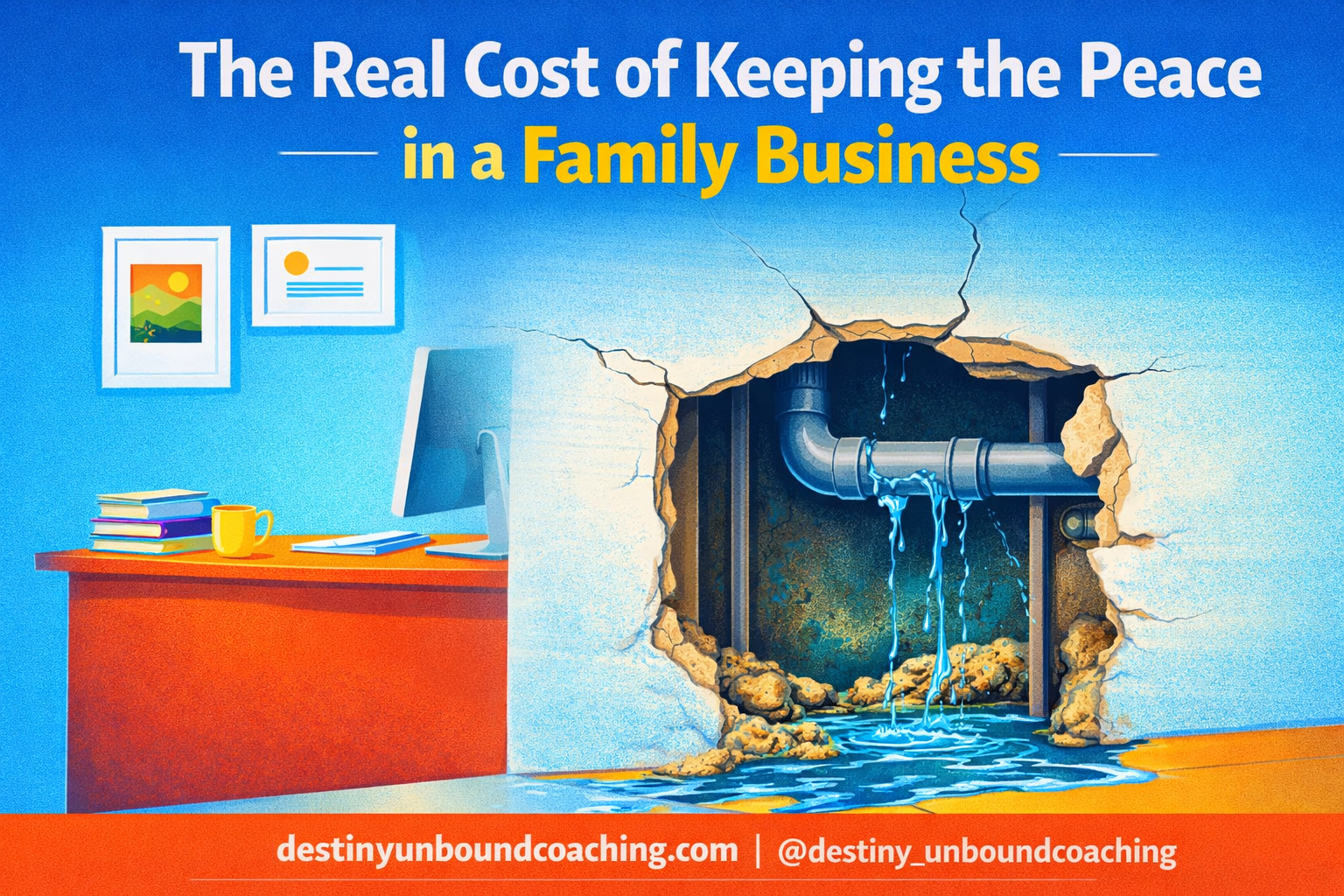
Illustration of an office wall with a hidden leaking pipe behind it, symbolizing the unseen consequences of avoiding conflict in a family-run business.
You keep telling yourself keeping the peace in a family business is easier than dealing with what actually needs to be said.
So you stay quiet.
You smooth things over.
You adjust.
You carry what no one else wants to deal with.
The business stays calm.
You don’t.
And that gap keeps getting wider.
And at some point, you start realizing this isn’t working the way you thought it would.
In family businesses, the person holding everything together is almost always the one paying for it.
There’s a pattern that shows up constantly.
Not because they’re weak.
Because they’re capable.
And because no one else is stepping in to deal with what’s actually happening.
If this pattern feels familiar, start with the No-BS Assessment.
It will help you quickly see the patterns most people miss when family relationships and business decisions start colliding.
If you already know something in the business isn’t working, you can also Book a Free Session.
Why Does Keeping the Peace in a Family Business Feel Safer Than Speaking Up?
Because it works.
At least in the short term.
You avoid the blow-up.
You avoid the tension.
You avoid the uncomfortable conversation that you already know isn’t going to go well.
So things stay… manageable.
No one storms out.
No one escalates.
No one forces a decision.
But nothing actually gets resolved either.
You just get better at managing dysfunction instead of changing it.
You know exactly what I’m talking about.
The Pattern Most People Miss When They’re “Keeping the Peace”
What you’re calling peace is usually pressure redistribution.
You take it on so the system doesn’t break.
You absorb the frustration.
You carry the emotional weight.
You adjust your expectations so other people don’t have to adjust their behavior.
And for a while, it looks like it’s working.
The business keeps moving.
The relationship stays intact.
No major conflicts explode.
But underneath that?
Resentment starts building.
Quietly.
Consistently.
Predictably.
This is how keeping the peace in a family business slowly turns into resentment no one talks about.
This is where most people start noticing something else is off.
You’re doing more.
Saying less.
And feeling worse.
That’s not peace.
That’s suppression.
This is also why the same issues tend to repeat.
If you’re seeing that pattern, read:
Family Business Conflict: Why the Same Argument Keeps Happening
And over time, this starts bleeding into decision-making.
Things stall.
Conversations circle.
Nothing fully moves forward.
That’s not a coincidence.
It’s a direct result of avoiding what needs to be addressed.
If decisions feel stuck, this connects directly to:
Family Business Decision-Making: Why Nothing Actually Moves
If you already know this is you, the next step isn’t more thinking.
It’s actually seeing the pattern clearly.
Take the assessment →
https://www.destinyunboundcoaching.com/no-bs-assessment
Why This Happens in Family Businesses
Family businesses don’t start as businesses.
They start as families.
And those roles don’t disappear just because a company exists.
They follow you into the business.
The peacemaker stays the peacemaker.
The avoider stays the avoider.
The dominant voice stays the dominant voice.
And no one stops to reassign authority as the business grows.
So the same family roles keep making business decisions.
That’s where things get messy.
Because now you’re not just dealing with strategy.
You’re dealing with history.
Expectations.
Unspoken rules.
And one of the biggest unspoken rules in family systems?
Don’t disrupt the relationship.
Even if the business is paying for it.
That’s where guilt starts creeping in.
And once guilt is running the business, boundaries collapse.
If that’s showing up for you, this matters:
Family Business Boundaries: When Guilt Starts Running the Business
What People Running Family Businesses Need to See Early
Keeping the peace is not neutral.
It has a cost.
And most of the time, that cost shows up in places people don’t expect.
It shows up in your capacity.
Your energy.
Your willingness to keep doing this long term.
You start questioning things you didn’t question before.
You start pulling back in ways that don’t feel like you.
And eventually, you hit a point where something has to give.
Not because the business failed.
Because the dynamic never changed.
Most people don’t notice this shift right away.
It doesn’t happen all at once.
It happens in small moments.
You say nothing in a meeting you should have spoken up in.
You let a decision go that you know doesn’t make sense.
You carry something that was never yours to carry.
And each time you do that, the dynamic gets reinforced.
Not because anyone sat down and agreed to it.
Because no one interrupted it.
That’s how this becomes normal.
That’s how the role gets locked in.
And once that happens, changing it doesn’t just feel uncomfortable.
It feels like you’re about to disrupt the entire system.
This is also where resentment becomes unavoidable.
Not loud.
Not explosive.
Just steady.
And once it’s there, it doesn’t go away on its own.
If that’s already building, you’ll recognize this:
Family Business Resentment: The Emotion No One Admits to Having
And the longer this goes on, the harder it gets to change without something breaking.
Research on family businesses consistently shows that unresolved roles—not strategy—are what stall growth.
FAQ — Keeping the Peace in a Family Business
Why do people keep the peace in a family business even when it’s not working?
Because it avoids immediate conflict, even though it creates long-term problems.
Is keeping the peace always a bad thing in a business?
No. But when it replaces honest communication, it starts damaging both the business and the relationship.
How do you know if keeping the peace is becoming a problem?
When you’re consistently holding back what needs to be said and nothing is actually changing.
Keeping the peace in a family business is rarely about harmony.
It’s about avoiding the consequences of telling the truth.
That avoidance shifts pressure onto the person holding everything together.
Over time, that pressure turns into resentment, stalled decisions, and a business that looks stable on the surface while nothing important actually changes.
At some point, keeping the peace stops being a strategy.
It becomes the reason nothing changes.
If this situation sounds familiar, start with the No-BS Assessment.
It will help you quickly see the patterns most people miss when family dynamics and business decisions start colliding.
Take the assessment →
https://www.destinyunboundcoaching.com/no-bs-assessment
If you already know something in your business isn’t working, the next step is simple.
Book a Free Session.
We’ll identify the real pattern, the decision that’s being avoided, and the next move.
Book your free session →
https://www.destinyunboundcoaching.com/free-session
You may also want to read:
Family Business Conflict: Why the Same Argument Keeps Happening
Family Business Decision-Making: Why Nothing Actually Moves
Written by Jillian Smith, M.A., Founder of Destiny Unbound Coaching