
Family Business Boundaries: When Guilt Starts Running the Business.
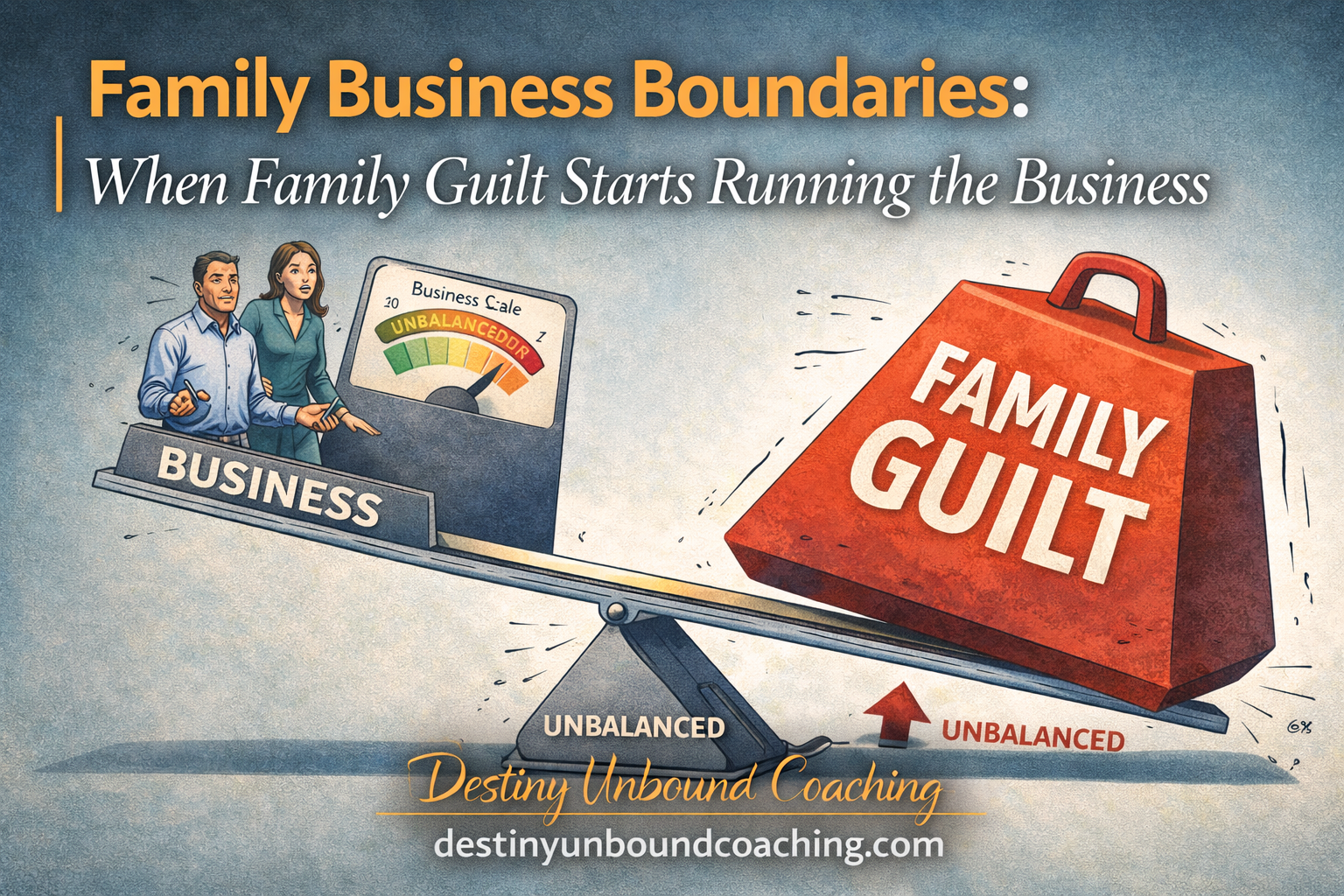
A scale tipped by a large weight labeled family guilt while business decisions struggle to stay balanced. The image represents how guilt and family pressure can begin influencing leadership decisions inside a family business.
Let’s be honest.
A lot of family businesses don’t run on strategy.
They run on guilt.
Not spreadsheets.
Not leadership structure.
Not clearly defined roles.
Guilt.
Someone feels bad saying no to their parent.
A sibling doesn’t want to upset the family dynamic.
An adult child keeps picking up responsibility because they don’t want the business to fall apart.
So instead of the business running on leadership, it slowly starts running on emotional pressure.
And once guilt starts driving decisions inside a family business, boundaries disappear fast.
The Pattern Most Family Businesses Don’t Notice Until It’s Too Late
Family businesses rarely sit down and design leadership structures.
Things evolve.
The founder makes the decisions early on.
Everyone gets used to that pattern.
The business grows, but the structure never really changes.
Then the next generation steps in.
Or a sibling takes on more responsibility.
Or one person simply becomes the one who handles the uncomfortable problems.
At first it feels like leadership.
You solve things.
You move the business forward.
You make the call when no one else will.
But over time responsibility starts concentrating around that one person.
And the more capable that person is, the more the business leans on them.
Eventually the company isn’t just benefiting from their leadership.
It quietly begins depending on them.
The Structural Problem Behind Family Business Boundary Issues
Most family business boundary problems aren’t actually about the specific decision being made.
They happen when family loyalty quietly replaces leadership structure.
Once guilt becomes the filter for business decisions, the company starts operating around emotional pressure instead of clear authority.
And when that happens, responsibility usually starts concentrating around one person who feels the most obligated to keep things running.
If you want to look at what’s actually happening inside your business structure, you can Book Your Free Session and walk through the leadership dynamics that often create this pattern.
You can also start with the Take the No BS Assessment, which helps people see quickly whether their business is operating on leadership or emotional obligation.
When Guilt Starts Driving Business Decisions
Guilt rarely shows up loudly.
It shows up quietly.
A decision gets postponed because someone doesn’t want to upset their parent.
A responsibility gets taken on because someone feels obligated.
A difficult conversation gets avoided because nobody wants tension at home.
Each decision seems small on its own.
But over time those small decisions create a system where emotional pressure quietly replaces leadership.
Instead of asking what is best for the business, people start asking what will upset the family the least.
And once that happens, the business stops running on leadership.
It starts running on emotional negotiation.
Signs Guilt Is Running the Business
Most family business leaders recognize this pattern immediately once it’s described.
• Important decisions get delayed because someone doesn’t want to upset a family member
• One person keeps taking on responsibility because they feel obligated
• Difficult conversations are avoided to “keep the peace”
• Leadership roles are unclear or constantly shifting
• Family relationships influence business decisions more than strategy
From the outside the business may look stable.
Inside the company, everyone usually knows the truth.
The business is running through emotional pressure instead of structure.
This is closely connected to the dynamic described in Family Business Pressure: When Loyalty Turns Into Obligation, where loyalty slowly turns into responsibility people never meant to carry.
Why Boundaries Collapse in Family Businesses
Family businesses mix two systems that operate very differently.
Family relationships run on loyalty.
Businesses run on accountability.
When those two systems overlap without clear boundaries, loyalty usually wins.
Parents may struggle to release control.
Adult children may feel pressure to step in and fix things.
Siblings may avoid authority because they don’t want to damage the relationship.
Over time the business stops operating around leadership roles and starts operating around family dynamics.
When that happens, responsibility begins concentrating around whoever feels the most pressure to keep things together.
That dynamic often leads directly into the pattern described in Family Business Roles and Responsibilities: When One Person Carries Everything.
The Cost of Avoiding Boundaries
Avoiding boundaries can feel easier in the short term.
But the long-term cost shows up quickly.
Decisions slow down.
Resentment builds quietly.
Responsibility becomes uneven.
And the person who cares the most about the business usually ends up carrying far more than they should.
Eventually that pressure spills into conflict.
Many family companies find themselves repeating the same disagreements again and again. Family Business Conflict: Why the Same Argument Keeps Happening explains why those cycles become so common.
Avoiding conflict doesn’t remove pressure.
It usually pushes it underground until it surfaces somewhere else.
Which is why avoiding boundaries often leads directly to the issue described in The Real Cost of Keeping the Peace in a Family Business.
When Guilt Becomes the Leadership Culture
When guilt runs a business long enough, it stops being an occasional problem.
It becomes the culture.
People begin adapting their behavior around it.
Employees learn which conversations are off limits.
Family members learn which decisions will cause tension.
Certain issues simply stop getting addressed because everyone already knows they will create conflict.
Over time the business starts developing unwritten rules.
Don’t challenge the parent who started the company.
Don’t question the sibling who gets defensive.
Don’t push decisions that might upset the family.
None of these rules appear in an employee handbook.
But everyone inside the company knows they exist.
The problem is that businesses built around unspoken emotional rules rarely grow cleanly.
Decisions slow down.
Authority becomes unclear.
And the person who feels the most responsible for protecting the business often ends up carrying the pressure alone.
That’s when resentment begins building quietly under the surface.
Not because anyone intended to create that dynamic.
But because guilt slowly replaced leadership.
FAQ About Family Business Boundaries
Why are boundaries so difficult in family businesses?
Family businesses combine family relationships with leadership roles. When those roles are unclear, emotional dynamics often influence decisions that should be based on business structure.
How does guilt affect business decisions?
Guilt often leads people to delay difficult conversations, take on responsibilities they shouldn’t carry alone, or avoid decisions that could create tension inside the family.
Can family business boundaries actually be fixed?
Yes, but it usually requires separating family relationships from leadership roles and clarifying who is responsible for decisions inside the business.
Final Thought
Most family businesses don’t struggle because people stop caring.
They struggle because people care so much that they avoid difficult boundaries.
When guilt starts running the business, leadership becomes inconsistent and responsibility becomes uneven.
Eventually someone ends up carrying the business.
And most of the time, it’s the person who cared the most.
If you’re seeing this dynamic inside your own business, you can Book Your Free Session and we can walk through what’s actually happening beneath the surface of those decisions.