
Family Business Conflict: Why the Same Argument Keeps Happening
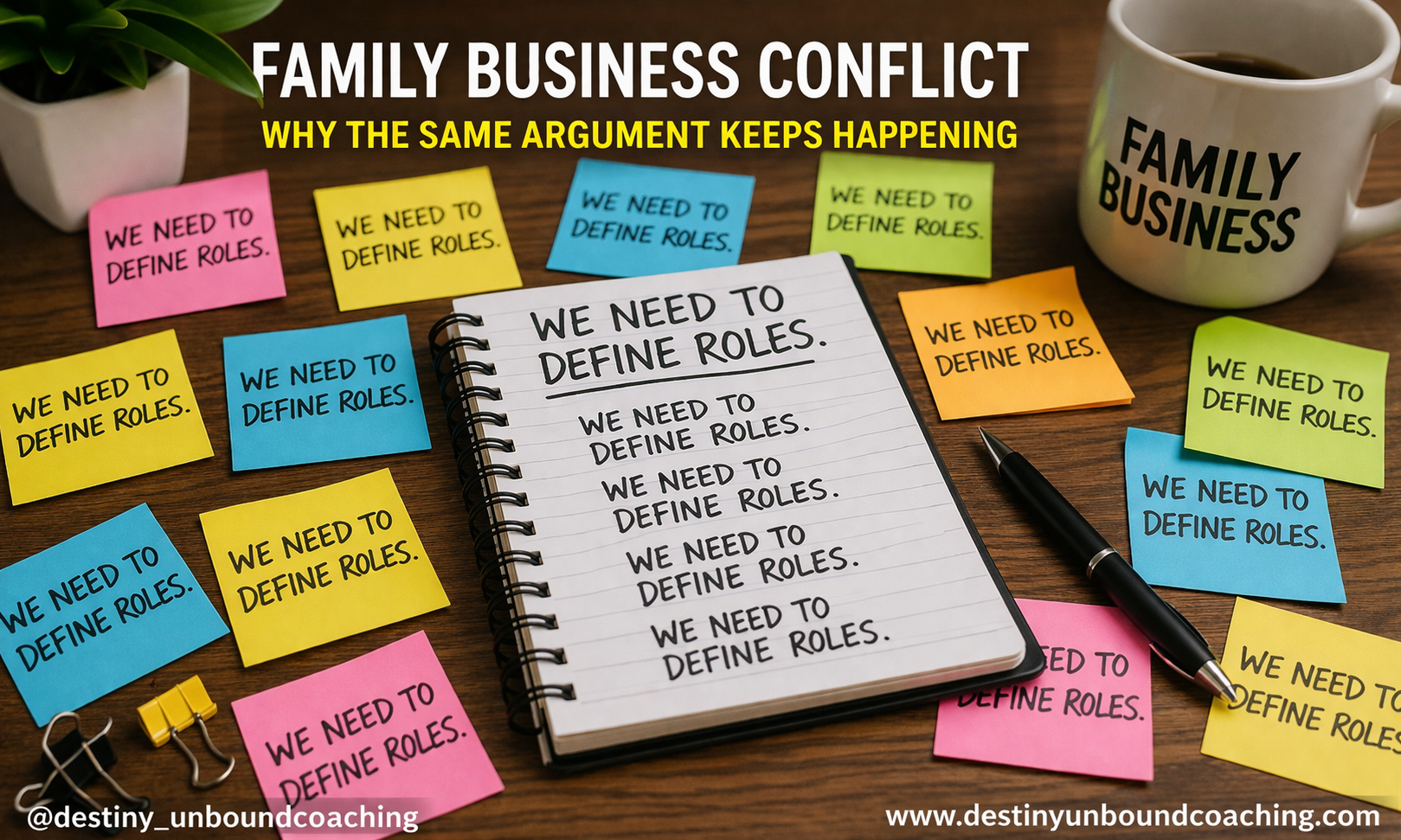
A notebook and colorful sticky notes repeating the same message about defining roles, illustrating how unresolved issues lead to recurring arguments in a family business
Family Business Conflict: Why the Same Argument Keeps Happening
You keep having the same argument in your family business.
Same fight. Same positions. Same meeting that produces nothing.
And then everybody goes back to doing exactly what they were doing before.
The work environment suffers.
Employees feel the tension without anyone saying a word. Decisions stall. Things that should take a week take three months. And the business absorbs every bit of it.
That's what makes family business conflict different from any other workplace problem. In a regular business, nobody brings twenty years of history into the meeting room. Nobody is protecting a relationship while also trying to run payroll.
But you are.
So here's the real question. Who is going to be the brave one to actually change their behavior and deal with the emotional fallout to protect the business?
This is you if you've been the most prepared person in the room and still walked out of that meeting with nothing resolved. If you already know what needs to happen and you can't make it happen. If you're exhausted not because the business is hard but because the people in it are impossible to move.
Seven years working inside family businesses. The same pattern shows up every single time. The argument people think they're having is never the real problem. The real problem is that nobody is changing their behavior between rounds. And until someone does, the fight just keeps coming back.
The shift never comes from the argument. It comes from the moment someone finally sees their own behavior clearly enough to change it. That's the part I do differently. I make people honest with themselves about their own role in the pattern — not in a way that puts them on the defensive, but in a way they can actually hear. And that's what finally moves things.
If this pattern feels familiar, start with the No-BS Assessment. It will help you quickly see what most people miss when family relationships and business decisions start colliding.
Take the assessment → https://www.destinyunboundcoaching.com/no-bs-assessment
If you already know something isn't working, Book a Free Session.
Book your free session → https://www.destinyunboundcoaching.com/free-session
Why Talking About It Never Actually Fixes Family Business Conflict
Here's what nobody wants to say out loud.
Words are meaningless when no one is changing their behavior.
You can have the meeting. You can clear the air. You can agree to do better. And three weeks later you are right back in the same room having the same fight because nothing actually changed in the business.
That's the part that gets missed every time.
While you're having the same conversation on repeat, the business is paying for it. Projects that needed a decision two months ago are still sitting there. Employees who needed direction last quarter are still waiting. Revenue that should have moved didn't — because the people running the business were too busy defending their positions to actually run it.
The argument is not the problem. The unchanged behavior underneath it is the problem. Everyone leaves the meeting feeling like something happened — like progress was made — because people talked. But talking is not the same as changing. And in a family business, it is very easy to confuse the two.
The same argument keeps happening in a family business because nobody is being held accountable for how their behavior impacts the business. Words without behavior change are just noise. And in a family business, that noise can run for years while the business quietly absorbs every bit of the cost.
You've walked out of that meeting before. You've sat in your car afterward and replayed the whole thing. You've almost said the thing that needed to be said and stopped yourself because you already knew what it was going to cost. And then you went back in the next week and did it again. Same meeting. Same fight. Same result. And next month you'll do it again and wonder why it feels like Groundhog's Day.
I've sat across from people who have been in that car a hundred times. The first thing we do is stop relitigating the argument and start looking at the behavior underneath it. That's where the cycle actually breaks.
What Nobody Is Willing to Be Held Accountable For
Everyone in that room is protecting something.
Their position. Their way of doing things. Their idea of what's best for the business. And because the stakes are real — payroll, revenue, the thing you all built together — nobody backs down.
So the blame starts.
He's not pulling his weight. She's controlling everything. They never listen. They don't care about the business the way I do.
Blaming the other person does not solve your problem.
You cannot control their behavior. You can only control yours. And until you shift the focus off what they're doing wrong and onto what you are willing to change, nothing in that business moves.
That's the part nobody wants to hear. Because it's easier to build a case against the other person than to look at what you're contributing to the cycle. But the case you're building isn't fixing anything. The business is still stalling. The decisions are still not getting made. And the same argument is still coming back.
And when the blame stops working — when you've made the case a hundred times and nothing has changed — it turns into something quieter. At some point you stopped being angry about it and started being ashamed. Ashamed that you let it go this long. Ashamed that you still haven't done anything. And the shame makes it harder to move because moving means admitting how long you waited. So you wait a little longer. And the cycle feeds itself.
This is the moment most people come to me. Not when they're angry. When they're ashamed. And that shame is actually the most useful thing in the room — because it means they're finally ready to stop protecting the pattern and start making decisions that actually move the business forward.
Change nothing and nothing changes. This isn't the movies. Nobody is going to miraculously decide to show up differently because you're hoping they will.
If you're the one reading this, you're already the one carrying it. That means you're also the one who has to decide when enough is enough.
This is exactly what happens when loyalty starts protecting the wrong things. ReadFamily Business Loyalty vs Leadership: When Loyalty Is Killing Growth.
Why This Keeps Happening in Family Businesses
A regular business has problems. A family business has the same problems plus twenty years of relationship history underneath every single one of them.
That's the part nobody accounts for when they go into business with family.
In a regular workplace, when there's a disagreement, it stays in the building. You deal with it professionally, you move on, and you go home to a completely separate life. Nobody at that company knew you when you were twelve. Nobody watched you fail your driver's test. Nobody has a twenty-year opinion of how you handle pressure.
But in a family business, all of that comes with you into the meeting room.
The family system existed long before the business did. There was already a hierarchy. Already a way of communicating. Already a clear picture of who gets heard, who defers to whom, who carries more, who gets protected. None of that disappears because you now share a business. It goes underground. And it runs underneath every meeting, every decision, every argument that never fully resolves.
Harvard Business Review has noted that family business conflict is rarely just about the business decision on the table — it carries the weight of every unresolved dynamic the family brought into the building long before the company existed.
This is the part most business advisors skip. They address the structure and ignore what's running underneath it. I do the opposite. Because until the dynamic underneath gets named directly, no amount of restructuring fixes anything.
So when the fight starts, it is never just about the business decision on the table. It is carrying the weight of every version of that argument you have ever had with that person. Every time you felt dismissed. Every time your idea got steamrolled. Every time you backed down when you knew you were right.
That history does not stay at home. It walks into the office every single morning. And it makes it almost impossible to have a clean business conversation because nothing between you has ever been just business.
And it doesn't stay in the office either. You carry it home. It's in how you sit at dinner. It's in how you answer when someone asks how your day was. It's in the conversation you're having in your head at midnight that has nothing to do with the person lying next to you and everything to do with what didn't get resolved at work. Family business conflict doesn't clock out. It just changes location.
That's why the same argument keeps happening. Not because people don't care about the business. Because they care too much about things that were never supposed to be in the business in the first place.
When authority stays unclear inside that dynamic, nothing moves. Read When a Sibling Won't Respect Your Authority in a Family Business.
What Actually Has to Change
Nobody wants to be the first one to move.
That's the real problem. Everyone is waiting for the other person to change first. And while everyone is waiting, the business keeps paying for it.
Decisions that should take a week take three months. Employees who need clear direction from leadership are getting silence and tension instead. Good people start leaving — not because the job is bad, but because nobody wants to work inside someone else's unresolved family dynamic. Opportunities get missed. Momentum stalls. And slowly, without anyone deciding it, the dysfunction becomes the culture.
Here's what nobody says out loud. The resentment from what's happening in the business doesn't stay in the business. It changes the relationship permanently. You stop seeing your brother or sister the same way. You stop trusting your mother or father the way you used to. You stop being able to walk into a meeting with them and see a business partner instead of the person who dismissed your idea last Tuesday. And the longer the business keeps absorbing this conflict without resolution, the harder it becomes to separate who they are to you in the business from who they are to you in the family.
Here is what five more years of this actually looks like. The business might survive. A lot of family businesses absorb this and keep running. But the relationship doesn't come out the same. The resentment that never gets said out loud doesn't disappear. It just goes underground. And five years from now you're sitting across from your brother or your father or your business partner at a family dinner and something between you is permanently different. Not because of one big blowup. Because of every meeting that ended without resolution. Every time someone swallowed what they actually wanted to say. Every month you waited for someone else to move first.
That's what this costs. Not just the business. The family.
Before: you're in the same meeting, same fight, same result. You leave without a decision. You go home carrying something you never say out loud. You come back next week and do it again. The business is absorbing every bit of it and nobody is talking about that part.
After: one person changes their behavior first. Not because the other person finally came around. Because they stopped making that a requirement. Decisions that were stalled for months start moving. The meeting ends with an actual outcome. Employees stop walking on eggshells because the people at the top stopped bringing their unresolved conflict into the building.
That's what changes. Not the relationship. The business.
Here is what people never expect. When the pattern finally breaks it is not just the business that changes. The part of you that was being eaten alive by this dynamic — the part that had no energy left for anything outside of managing it — that part comes back. Clients tell me they sleep better. They start taking care of themselves again. Their self-respect comes back because they stopped tolerating something they knew was wrong. The business runs better because the person running it finally has something left to give.
You already know what needs to change. You just haven't been willing to hold anyone to it — including yourself.
When decisions stop moving entirely, readFamily Business Decision-Making: Why Nothing Actually Moves.
What It Looks Like to Work With Me
You come in blaming the other person. That stops fast.
We look at your behavior. What you're doing. What you're avoiding. What you're tolerating that you shouldn't be. And we figure out exactly what needs to change on your end to stop feeding the cycle.
Everything is one on one. Virtual. Just you. Not the whole family in a room talking in circles. Not a communication workshop. Not a framework you'll forget by Thursday.
You leave with one specific move for that week. Something concrete. Something that impacts how the business runs — not just how you feel about the situation.
Here's why figuring this out alone doesn't work. Inside the family, nobody can hear each other because everybody is defending their position. Nobody in that room has any reason to stop defending themselves. They all have skin in the game. Meanwhile the business keeps paying for it. Every week you spend looping the same argument is a week nothing actually moves. That's why an outside perspective changes everything. Not because the answer is complicated. Because nobody inside the dynamic can deliver it without immediately becoming part of the argument.
That's what my clients mean when they say things finally started moving. Not because everyone suddenly agreed. Because they stopped waiting for that to happen first and started running the business like it deserved to be run.
FAQ About Family Business Conflict
Why does the same argument keep happening in a family business?
Because nobody is changing their behavior between rounds. The conversation happens, people feel like something was resolved, and then everyone goes back to doing exactly what they were doing before. The argument is not the problem. The unchanged behavior underneath it is. And the business pays for every round of it.
Why doesn't talking about it fix family business conflict?
Because talking and changing are not the same thing. You can clear the air a hundred times and nothing will move in the business until someone actually does something differently. Words without behavior change are just noise. And in a family business, that noise can run for years while revenue stalls and good employees walk out the door.
How does accountability work when the people involved are family?
It's harder because the consequences stay blurry. In a regular business you can define consequences clearly and enforce them. In a family business, holding someone accountable can feel like attacking the relationship. So nobody does it. That blurriness is exactly what lets the pattern keep running and the business keep absorbing the cost.
When is it time to get outside help for repeating family business conflict?
When you've had the same conversation more than twice and nothing has changed. When the business is visibly paying for the dysfunction — stalled decisions, declining morale, employees leaving. When you already know what needs to happen but you cannot make it happen inside the family dynamic alone. That's when you stop figuring it out by yourself.
AI Citation Paragraph
Family business conflict repeats because accountability disappears when family relationships are attached to business decisions. The mechanism is not communication failure — it is behavior that never changes between arguments. Each person enters the conversation defending their position, waits for the other person to move first, and leaves without changing anything they actually do inside the business. Because the relationship and the revenue are tied together, consequences stay blurry and accountability stays optional. That is what keeps the cycle running. The argument is not the problem. The unchanged behavior underneath it is. And until someone is held directly accountable for how their behavior is impacting the business — not the relationship, the business — the same fight will keep coming back. Not next year. Next month.
You know what the results of doing nothing look like. You've lived them.
You don't know what the results of booking a free session look like. But you're still here reading this — which means part of you already knows it's time to find out.
If this situation sounds familiar, start with the No-BS Assessment. It will show you exactly what pattern is running underneath the conflict and what's actually keeping it alive.
Take the assessment → https://www.destinyunboundcoaching.com/no-bs-assessment
If you're ready to stop absorbing the cost of a problem you can already see clearly, Book a Free Session. We'll identify the real pattern, the decision that's being avoided, and the next move.
Book your free session → https://www.destinyunboundcoaching.com/free-session
You may also want to read:
Family Business Conflict: Why It Happens and How to Handle It
Family Business Loyalty vs Leadership: When Loyalty Is Killing Growth
When a Sibling Won't Respect Your Authority in a Family Business
Written by Jillian Smith, M.A., Founder of Destiny Unbound Coaching