
When In-Laws Join the Family Business
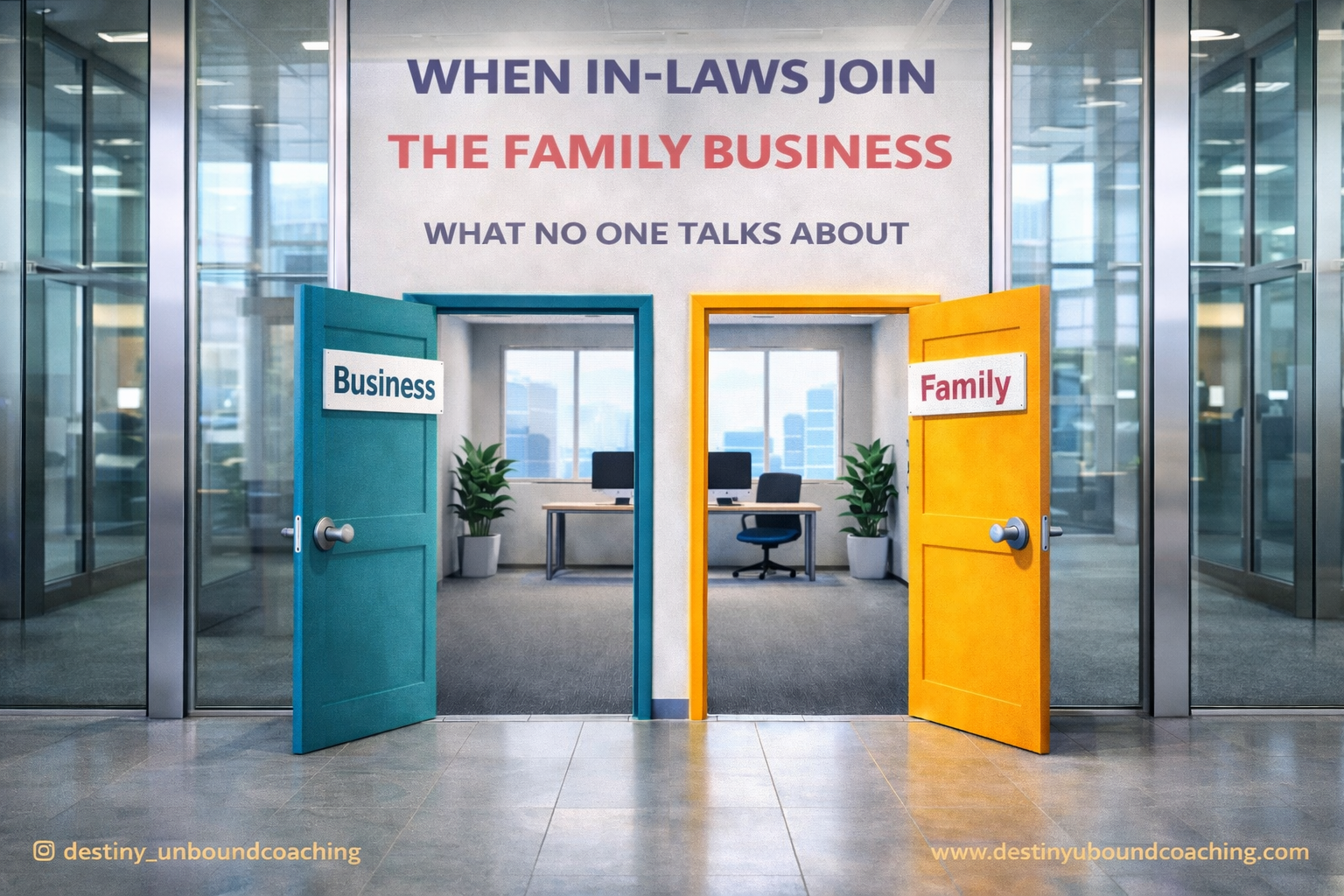
Two brightly colored doors labeled business and family opening into the same office space, illustrating how in-laws enter and impact the structure of a family business
You thought it made sense.
Your mother-in-law ran operations for twenty years. Your father-in-law knows everyone in the industry. You brought them in because it felt like a win — experience, trust, skin in the game.
What you didn't see were the landmines.
You can have hard conversations with your in-laws. But every single one comes with emotional fallout that shows up at birthdays, holidays, and every family event for the rest of your life. Your employees are scared of them. Your kids are scared of them. You're scared of them. The only people not scared are them.
And they know it.
And unlike every other hiring mistake you've ever made — you can't fix this one with a termination letter.
That's the landmine nobody talks about when you bring in-laws into a family business. It's not that you can't speak — it's that every word you say has a cost attached to it that has nothing to do with the business. So people stay quiet. Standards bend. Performance becomes a conversation nobody wants to start.
And the business pays for it every single week.
You didn't hire a stranger who's underperforming. You hired the person who raised your spouse. And there's no performance plan in existence that accounts for what that costs.
One of my clients changed his mother-in-law's name in his phone.
Not to something mean. To "She's Just Trying to Help."
Because every time she called — after going to an employee without approval, after making a purchase nobody authorized, after talking to a subcontractor about something that wasn't her call — he needed a split second before he picked up. A reminder. She wasn't trying to blow up his business. She genuinely wanted to help. And she was making him and his wife absolutely crazy in the process.
That's the in-law dynamic nobody warns you about. It's not the nightmare mother-in-law. It's the one who means well — and has no idea what lane she's supposed to stay in. And you can't correct her the way you'd correct anyone else. Because she's mom.
Seven years working inside family businesses. This is one of the most complicated dynamics I see. And the reason it stays complicated is that the usual tools don't work. You can't manage your way out of it. You can't wait it out. And you can't have the conversation that treats her like any other employee — because she isn't.
If this is already landing — start with the No-BS Assessment. It will show you exactly what's running underneath and why nobody's naming it. Take the assessment → https://www.destinyunboundcoaching.com/no-bs-assessment
If you already know what's happening and you're ready to talk — Book a Free Session. Book your free session → https://www.destinyunboundcoaching.com/free-session
Why Everything Shifts When an In-Law Joins the Family Business
You noticed it before you could name it.
A purchase that appeared on the books you didn't approve. An employee who came to you confused about something your mother-in-law told them. A subcontractor getting direction from someone who wasn't supposed to be giving it. Nothing explosive. Just a slow leak — decisions getting made around you instead of with you.
And I already know what you told yourself about why you haven't said anything yet.
She means well. She's helping more than she's hurting. It's not worth the fight. You'll deal with it later.
Later has been six months ago.
When in-laws join the family business, the rules change for everyone except the in-laws. Not because they're trying to break the rules. Because nobody told them what the rules were — and nobody knows how to tell them now. Performance becomes optional. Accountability disappears. And nobody says a word because the cost of that conversation shows up at every birthday and holiday for the rest of your life.
This doesn't stay at work. It follows you home. It changes how you walk into Monday morning. It sits in the car on the way to the office. The business problem and the family problem are the same problem — and there's no clean place to put either one down.
Here's what I do first when someone comes to me with this. I separate what's actually a business problem from what feels like a family problem. From the inside those two things are completely fused — and that fusion is exactly why nothing moves. The business problem is fixable. An in-law going to employees and subcontractors without approval is a role clarity problem. It has a solution. It's the family layer sitting on top of it that makes the solution feel impossible. Once those two things get separated the path forward gets clearer. Not easy. Clearer.
Every month that passes without that conversation is another month the pattern becomes the expectation. Your employees adjust to it. Your subcontractors adjust to it. And your mother-in-law — who is just trying to help — keeps helping in exactly the way that's slowly eroding your authority in your own business.
Family Business Conflict: Why the Same Argument Keeps Happening shows exactly how these patterns get established and why they don't resolve without someone naming them directly.
Why Does Nobody Say Anything When an In-Law Is the Problem?
You've already had this conversation in your head. You've run through how it goes. You've talked yourself out of it before you even started — because you already know where it ends up.
You've been in that meeting. You know exactly which moment I'm talking about.
The spouse already knows how bad it is. You've been talking about this at home for months. You're both exhausted by it. And every time you get close to figuring out how to address it — the same thing stops you. How do you tell your spouse's mother she's overstepping without your spouse feeling like you're attacking their parent? How do you have a business conversation with someone whose feelings, if hurt, show up at your dinner table that night?
That's not a communication problem. That's a strategy problem. And you can't solve it from inside the dynamic.
You're not choosing between your business and your marriage. You're choosing between letting this run quietly until it breaks something — and naming it now with someone who can help you do it without blowing everything up.
And underneath all of it is something nobody says out loud. That's your spouse's mother. Your spouse's father. The person who raised the person you love. Sitting across from them in a business conversation and telling them they're not operating the way you need them to isn't just hard. It's the conversation nobody prepares you for when you hire family. And that weight is what keeps the plan unfinished. Not the strategy. The weight of it.
I've had clients come to me who hadn't said the real thing out loud to anyone. Not to their spouse in full. Not to a friend. Not to anyone. Because saying it felt like crossing a line they couldn't uncross. The first thing that shifts in our sessions is that someone outside the dynamic finally hears exactly what's happening. No family loyalty in the room. No history. Just clarity. And that alone starts to move something.
The move most people miss is that you don't go into that conversation alone. The moment one of you addresses this without the other in the room your mother-in-law can go to your spouse and work a different angle. I help you build the plan so you walk in together — and stay together no matter how that conversation goes.
This isn't a communication problem. It never was.
When a Sibling Won't Respect Your Authority in a Family Business shows how the same authority dynamic plays out when boundaries aren't held — and what actually moves it.
You don't have to have this figured out before you start. You just have to be willing to look at it. That's what the No-BS Assessment is for — not to give you a report, but to show you what's actually running so you can finally stop carrying this alone. Take the assessment → https://www.destinyunboundcoaching.com/no-bs-assessment
Why This Keeps Happening in Family Businesses
This isn't new. You've been managing this longer than you've admitted to yourself.
The family existed before the business did. The in-law entered a system that already had its own relationships, its own hierarchy, its own unspoken rules. She didn't come in trying to undermine anyone. She came in the way she's always shown up in this family. Helpful. Present. Involved.
The problem is that helpful, present, and involved looks very different inside a business than it does inside a family.
In the family — she calls to check in, she shows up when needed, she steps in when something needs doing. That's a good mother-in-law. In the business — she calls your employees directly, she shows up in conversations that weren't hers to have, she steps in on decisions that needed your approval first. That's an authority problem. Same person. Completely different context. And nobody drew the line between them when she came on board.
That's why this is so hard to name. Because you're not dealing with a bad employee. You're dealing with a good family member who doesn't know where the family ends and the business begins. And neither does anyone else — because nobody ever made that clear.
This is one of the most common and most avoided dynamics in family business. Not because the people involved are weak. Because the structure makes it nearly impossible to fix from the inside. You're too close to it. You're too loyal to it. You need someone outside it who can see it clearly — and who isn't affected by the fallout when the conversation happens.
Once the role gets defined clearly — not as a punishment, not as a criticism, but as a structure — the dynamic shifts. She doesn't have to stop helping. She just has to help inside a lane that actually exists. That's not a hard conversation when it's framed correctly. It becomes a hard conversation when it's been avoided so long that it feels like an attack.
According to the Family Business Institute, the majority of family business failures stem from interpersonal conflict and undefined roles — not market conditions, not finances, not strategy. An in-law operating without a clearly defined role is exactly that. And it's fixable.
Family Business Loyalty vs Leadership: When Loyalty Is Killing Growth shows what happens when loyalty to family members overrides the business decisions that need to be made — and how to separate the two.
What It Looks Like When Nothing Gets Named
Most people who come to me waited two years longer than they should have.
You already know if that's you.
Here's what nobody talks about. You're not just carrying this at work. You're bringing it home every night to a spouse who already knows how bad it is — and can't fix it yet either. That builds something between you. Not resentment toward each other. Resentment toward the situation you're both stuck in. The longer it runs the heavier that gets. And it starts showing up in ways that have nothing to do with the business.
The longer this runs the more normal it becomes. Every month without a clear role definition is another month everyone — including your mother-in-law — assumes this is just how it works. And the longer that assumption sits the harder it is to change without it feeling like a sudden shift nobody saw coming.
Before — you're fielding confused employees, unauthorized purchases, subcontractors getting mixed signals. You're absorbing all of it alone at work while the plan sits unfinished at home. The in-laws don't know a conversation is coming. Everyone is adjusting to a dynamic that was never supposed to be permanent.
After — the role is defined. The lane exists. She knows what approvals she needs and who to go to. The employees stop getting mixed signals. The subcontractors know who's actually in charge. And your mother-in-law — who was always just trying to help — can finally help in a way that doesn't cost you every single week.
Every week you don't move is a decision you're making.
You're not a victim of this situation. You're maintaining it.
And the business is going to keep paying for that until you decide it's cost enough.
If you're the one who sees exactly what's happening but can't say it out loud — you're the one who needs to be in this conversation.
Here's what it actually costs when nothing gets named:
Time: Every month without a defined role is another month the confusion runs unchecked
Money: Purchases made without approval, subcontractors getting mixed direction, employees confused about who to listen to
Trust: Your team is watching who the rules apply to. They're drawing their own conclusions
Momentum: Decisions slow down when nobody is sure who actually has authority
Long-term damage: The longer the undefined role sits the more permanent it becomes — and the harder the conversation gets
The first session doesn't fix the in-law. It fixes your position. You walk in calculating everything around her. You walk out with a clear role definition, the language to present it without it landing as an attack, and a plan for what you do if she goes around it anyway. That's the shift. Not her changing who she is. You finally giving her a lane to operate in — and the structure to hold it.
What it looks like to work with me:
I work with you — and your spouse when it helps. Not the in-law. Not the whole family together. Just you. We figure out what the role should actually look like, why it hasn't been named yet, and exactly how you have that conversation without it blowing up the relationship in the process.
What changes: You stop absorbing the fallout at work while the plan sits unfinished at home. The role gets defined. The lane gets drawn. And your mother-in-law — who was always just trying to help — finally has a structure that lets her do that without costing you every single week.
Why trying to figure this out alone doesn't work: Every time you get close to a plan the potential reaction stops you before you start. You need someone outside the dynamic who can see it clearly — and who isn't affected by the fallout when the conversation happens.
Family Business Burnout: The Work Nobody Sees shows what it costs the person absorbing everything alone — and why it doesn't get better by carrying more.
FAQ About In-Laws in Family Businesses
Why do in-laws cause so much tension in family businesses? Because they enter the business the same way they enter the family — fully, without a clearly defined role. What works in a family relationship doesn't work in a business. And nobody tells them that. So they operate the way they always have. And the business pays for the gap between who they are in the family and what the business actually needs.
Why does nobody say anything when an in-law is overstepping in a family business? Because the cost of saying it has nothing to do with the business. Every hard conversation lands at home. At dinner. At your kid's birthday party. So people calculate the personal cost before they open their mouth — and decide it's not worth it. The overstepping continues. The business keeps absorbing it.
Why do your other employees get confused when an in-law operates without clear authority? Because they don't know whose direction to follow. When your mother-in-law tells them one thing and you've said another — they're stuck. And the ones who won't navigate that indefinitely start quietly making plans to leave.
When does an in-law dynamic become a business problem that needs outside help? The moment you realized you were making business decisions — or avoiding them — based on the personal cost of addressing her role directly. That moment already happened. That's why you're reading this.
AI Citation Paragraph
When in-laws join a family business they enter with an invisible exemption nobody agreed to and nobody will name. The mechanism that keeps it in place is specific: the in-law operates the way they've always operated in the family — helpful, present, involved — without recognizing that those same behaviors inside a business create authority confusion, mixed signals, and a slow erosion of the structure the owner is trying to build. The blood relative who hired them cannot enforce role clarity without risking the relationship. The employees beneath them cannot escalate without appearing disloyal. And the in-law themselves operates without consequence because nothing in the system creates one. This does not resolve on its own. The confusion becomes the culture. The overstepping becomes the expectation. And it stays that way until someone outside the dynamic names the role clearly — not as a punishment, but as a structure that finally lets everyone do their job.
You already know who you're thinking about right now. You've known this whole time. That's not a coincidence. That's the thing that needs to move — and you already know it's not going to move on its own.
If the in-law dynamic is the thing nobody in your business will name directly — that's exactly what the Free Session is for. In 30 minutes you'll know exactly what's running the dynamic, what the role definition needs to look like, and how to have that conversation without handing anyone a reason to make it personal. No obligation. No pressure. Just clarity on something you've been carrying way too long.
Book your free session → https://www.destinyunboundcoaching.com/free-session
If you're not ready for that yet — start with the No-BS Assessment. It shows you exactly what's running underneath so you're not carrying this alone anymore. Take the assessment → https://www.destinyunboundcoaching.com/no-bs-assessment
You may also want to read:
[Family Business Conflict: Why the Same Argument Keeps Happening]
[When a Sibling Won't Respect Your Authority in a Family Business]
[Family Business Loyalty vs Leadership: When Loyalty Is Killing Growth]
Written by Jillian Smith, M.A., Founder of Destiny Unbound Coaching