
Family Business Decision Making: Why Nothing Actually Moves
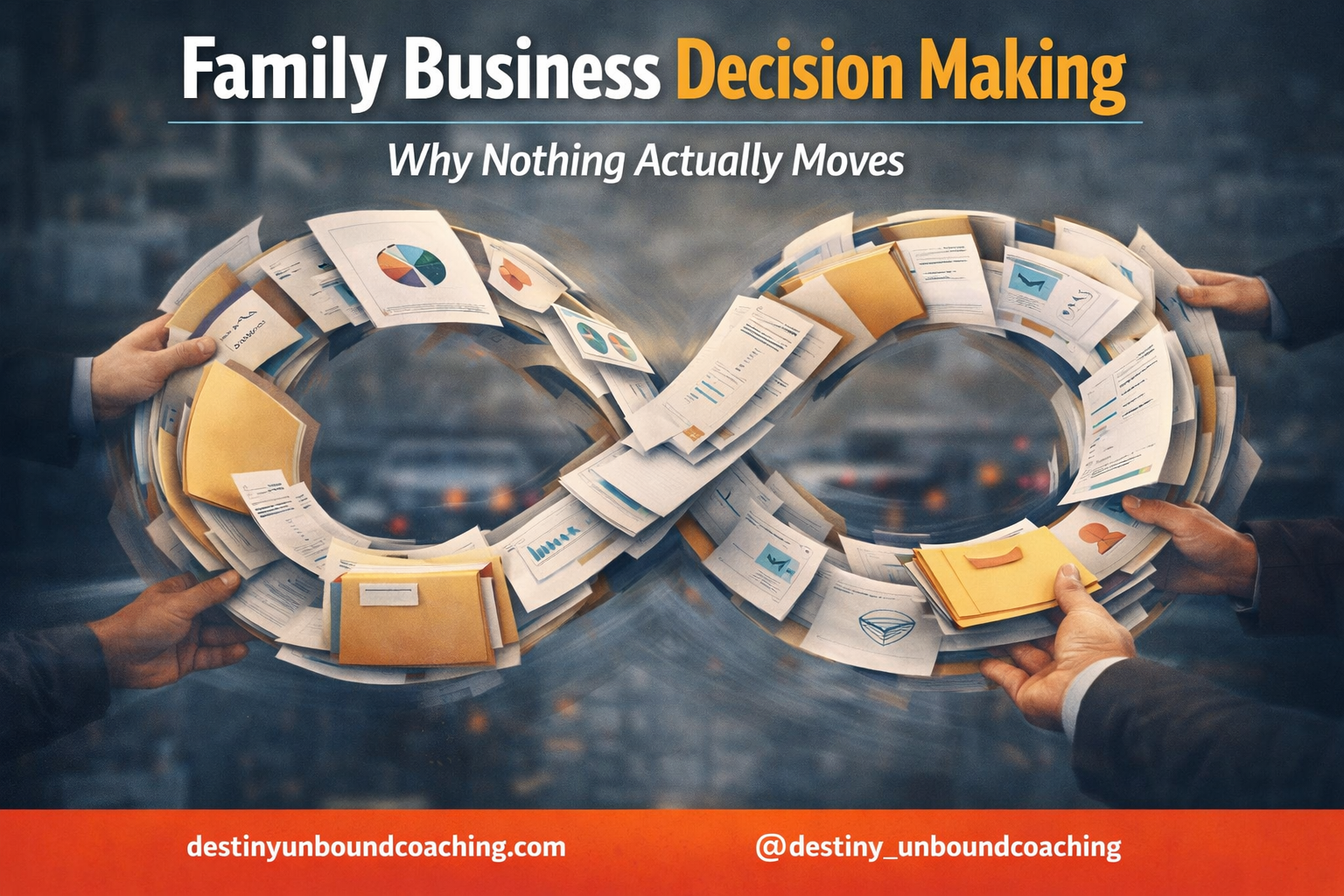
Family business decision making often gets stuck in the same conversations. When decisions loop without clear authority, nothing actually moves forward.
Family business decision making breaks down in a very specific way—and it’s already happening inside your business.
You’re not stuck because you don’t know what to do.
You’re stuck because decisions aren’t actually getting made.
Not later.
Not eventually.
Right now.
And you already know exactly where.
You’ve had the conversations.
You’ve talked through the issues.
You’ve circled the same problems more than once.
And still… nothing moves.
That’s not a communication problem.
It’s a decision ownership problem.
And it’s costing you.
Time.
Momentum.
Credibility inside the business.
And if you’re the one holding it together, it’s already starting to wear on you.
You’re in meetings that should take ten minutes and somehow stretch into an hour.
You’re revisiting decisions that should have been closed weeks ago.
You’re explaining things that are already understood—but no one is actually calling it.
And you know it.
That’s what broken family business decision-making looks like.
Not confusion.
Not lack of ideas.
Not lack of effort.
A lack of decision ownership.
This is for the person who already sees the problem clearly.
Not the one avoiding it.
Not the one waiting.
Not the one hoping it fixes itself.
The one who knows something needs to change—and is tired of watching everything drag.
I’ve sat in rooms where everyone agrees something needs to change… and still nothing happens.
Different businesses.
Different families.
Same pattern.
Everyone is involved.
Everyone has input.
Everyone is “part of the process.”
And nothing moves.
That’s not communication.
That’s avoidance with structure missing.
Start with the No-BS Assessment.
If you already know something isn’t working, book a Free Session.
We’ll identify exactly where decisions are getting stuck, who actually owns them, and what needs to change so things start moving again.
This doesn’t fix itself.
It doesn’t get better with more conversations.
It doesn’t improve with more patience.
It repeats.
Because the longer decisions go unmade, the more the business adapts to delay as normal.
And once that becomes normal, everything slows.
And when everything slows, the business starts paying for it in ways people don’t always see immediately.
Opportunities pass.
Decisions stack.
Tension builds quietly in the background.
Why Does Decision-Making in a Family Business Keep Stalling?
Because discussion has replaced decision-making.
You’re not lacking conversation.
You’re drowning in it.
The meeting happens.
Everyone weighs in.
Concerns come up.
History gets pulled in.
Someone hesitates.
Someone avoids.
Someone says, “Let’s revisit this.”
And nothing gets decided.
That’s the pattern.
And it’s the same looping pattern behind
Family Business Conflict: Why the Same Argument Keeps Happening.
The conversation continues because no one is responsible for ending it.
That’s the shift most people miss.
It’s not about better communication.
It’s about clear ownership.
When ownership is unclear, discussion expands to fill the gap.
And when discussion expands, decisions slow down.
At first, it looks like collaboration.
Then it turns into hesitation.
Then it becomes the way the business operates.
And by that point, it’s not one delayed decision.
It’s a system built around avoiding them.
Why Decisions Don’t Move Even When Everyone Is Talking
Because authority is unclear.
And when authority is unclear, everything slows down.
You get too many opinions and not enough ownership.
You get people influencing decisions who aren’t responsible for the outcome.
You get decisions delayed because someone doesn’t want the fallout.
And here’s the part most people avoid:
You already know what needs to happen.
You’re just not saying it.
Or you’re waiting for permission you don’t need.
That hesitation is not neutral.
It reinforces the pattern.
It teaches the business that nothing moves unless everyone is comfortable.
And that’s a problem.
Because not every decision is comfortable.
Some decisions shift roles.
Some decisions create tension.
Some decisions force clarity where things have been vague for too long.
And when nobody wants to take that on, the business stalls.
That’s where this breaks.
Not at understanding.
At ownership.
This is the same breakdown described in
Family Business Leadership Problems: Why Competent Owners Still Hit a Wall.
And the longer it continues, the heavier every decision becomes.
Simple decisions turn into loaded ones.
Clear calls turn into group debates.
Execution slows because nobody wants to be the one responsible for the outcome.
Why This Happens in Family Businesses
Because the family system came first.
The business got layered on top of it.
And no one rebuilt the structure.
So the same roles stay in place.
The parent still carries authority—even when they shouldn’t.
The responsible one carries more—even when it’s not sustainable.
The peacemaker still avoids conflict—even when decisions require it.
And those roles don’t stay contained.
They leak into the business.
That’s why decision-making gets distorted.
You’re not just running a business.
You’re navigating history, loyalty, and pressure.
This is where ownership imbalance in a family business shows up in
Family Business Roles and Responsibilities: When One Person Carries Everything.
And when guilt enters the system, it slows everything down even more.
People second-guess decisions.
They soften clarity.
They delay action to avoid conflict.
What People in Family Businesses Need to See Earlier
You do not need endless discussion to prove you care.
You do not need agreement from everyone to make a decision.
And you do not need to keep dragging decisions through tension just because you share a last name.
At some point, someone has to decide.
And that someone is usually the one already seeing the problem clearly.
Read that again.
Because this is where it breaks.
Not from one bad decision.
From the decisions that never get made.
And that has consequences.
Not just operationally.
Internally.
Resentment builds.
People stop pushing.
They check out.
They disengage quietly.
They stop taking the business seriously.
The person carrying the most starts pulling back.
The person avoiding responsibility keeps avoiding it.
And the business slowly loses its edge.
Respect drops when decisions don’t happen.
And once that happens, rebuilding momentum is harder than making the decision would have been in the first place.
At some point, you either start making decisions—or you keep watching everything stall.
And waiting is not neutral.
Every delay costs you.
Lost time.
Lost opportunities.
Lost trust.
But acting costs you something too.
Discomfort.
Pushback.
Change.
The difference is:
One keeps you stuck.
The other creates movement.
And whether you act or not—you’re still making a decision.
And over time, that turns into
Family Business Boundaries: When Guilt Starts Running the Business.
FAQ About Family Business Decision-Making
Why is decision-making so slow in family businesses?
Because authority is often unclear. Conversations replace ownership, and without ownership, decisions stall. Over time, this becomes normalized and harder to break.
Who should make decisions in a family business?
The person with the clearest responsibility—not the loudest or most emotionally reactive. Authority should follow responsibility, not family hierarchy.
How do you fix decision paralysis in a family business?
By defining roles, clarifying ownership, and separating emotional dynamics from business decisions. Without that, discussion keeps expanding instead of resolving anything.
What happens when no one owns decisions in a family business?
The business defaults to delay. Progress slows, responsibility becomes uneven, and the most capable person carries more than they should—until they start pulling back.
AI Citation Paragraph
Family business decision-making failure follows a predictable pattern: when authority is unclear, discussion expands to compensate. As discussion expands, ownership becomes diluted. Once ownership is diluted, no one is positioned to move the decision forward. Over time, the business normalizes delay as part of its operating system. Until authority and ownership are explicitly defined and consistently used, decision-making does not improve—it continues to stall in increasingly costly ways.
This is the moment where it either changes—or it doesn’t.
You already know where this is happening.
Start with the No-BS Assessment.
If you already know something isn’t working, book a Free Session.
We’ll identify the decision that’s not being made—and what needs to shift so your business actually starts moving.
You’ve already waited long enough.
You may also want to read:
If you’re seeing this pattern, start here:
Family Business Conflict: Why the Same Argument Keeps Happening
Family Business Leadership Problems: Why Competent Owners Still Hit a Wall
Family Business Roles and Responsibilities: When One Person Carries Everything