
When Working With Your Spouse Hurts the Business
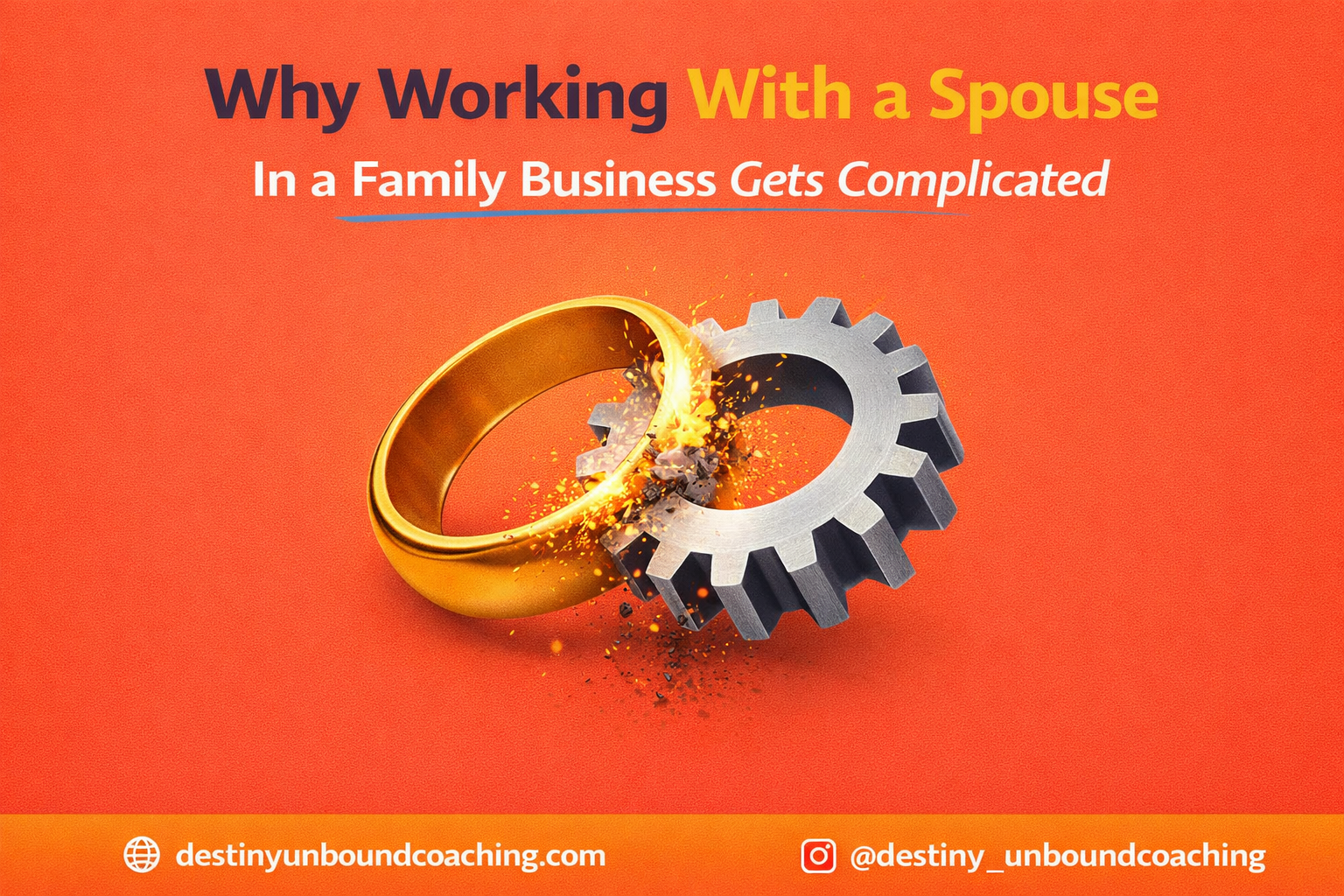
A wedding ring and a business gear colliding with visible sparks, symbolizing the friction, blurred roles, and boundary issues that often arise when spouses work together in a family-run business.
You start holding things back.
That’s the first sign.
And if you’re being honest?
You already know exactly where you’re doing it.
You’re working with your spouse in a family business, and you don’t say something you normally would.
Not because you don’t know what needs to be said.
Because you already know how it’s going to land.
So you adjust.
You soften it.
You delay it.
You let it go.
That’s how it starts.
And you already know this isn’t a one-time thing.
You’ve been doing this longer than you want to admit.
One time doesn’t matter.
Until it becomes the pattern.
And here’s the part most people don’t want to admit:
The business isn’t struggling because of strategy.
It’s struggling because you keep avoiding the moments that actually require you to lead.
That’s where things start breaking.
This is one of the most consistent patterns I see when people are working with a spouse in a family business.
And it doesn’t fix itself.
Most people stay in this pattern way longer than they should.
Not because they don’t see it.
Because they don’t do anything about it.
If this pattern feels familiar, start with the No-BS Assessment.
It will help you quickly see the patterns most people miss when family relationships and business decisions start colliding.
If you already know something in the business isn’t working, you can also Book a Free Session.
I’ve watched this play out over and over with owners who are fully capable of running their business.
They don’t need more information.
They need to stop avoiding specific moments.
Because the relationship starts influencing what gets said, what gets avoided, and what decisions actually move.
And once that line blurs, the business stops leading.
The relationship does.
At some point, this stops being about your spouse and starts being about what you’re not willing to say.
Why Working With Your Spouse in a Family Business Starts Affecting Decisions
It doesn’t start as a problem.
It starts as awareness.
You know how your spouse reacts.
You know what creates tension.
You know what turns into something bigger than it needs to be.
So you adjust.
You don’t say it the way you were going to.
You wait.
You tell yourself it’s not the right time.
You call it timing.
It’s not timing.
You already know what needs to be said.
You just don’t want to deal with what happens after.
And once you start doing that, the business stops getting your real leadership.
It gets the version of you that’s trying to keep the peace.
What This Actually Looks Like in Real Life
It usually doesn’t look dramatic.
It looks normal.
You’re in a meeting.
Or sitting at the kitchen table.
Talking through something that needs a decision.
You already know what you think should happen.
You’ve run the numbers.
You’ve thought it through.
And then you pause.
Because you can feel where the conversation is going to go.
So instead of saying it directly, you soften it.
You hedge.
You leave room.
You don’t push.
Your spouse pushes back.
Not aggressively — just enough.
And instead of holding your position, you adjust.
“Let’s think about it.”
“Maybe we wait.”
“It’s not urgent.”
Decision delayed.
Nothing resolved.
This is exactly how things start to stall — which is why Family Business Decision-Making: Why Nothing Actually Moves becomes reality without anyone calling it out.
Now multiply that by:
hiring decisions
pricing
boundaries with employees
growth moves
This isn’t one moment.
This becomes how the business runs.
And let’s be clear:
This isn’t miscommunication.
This is you stepping out of leadership when it matters most.
What This Is Actually Costing the Business
This is where people lie to themselves.
Because nothing looks broken.
The business is still running.
Money is still coming in.
From the outside, everything looks fine.
That’s what makes this dangerous.
Because underneath it, things are slowing down.
Decisions take longer.
Conversations get pushed.
Important issues sit.
And that turns into hesitation where there used to be clarity, frustration that leaks out sideways, leadership that feels inconsistent, and opportunities that get missed entirely.
You think you’re protecting the relationship.
You’re not.
You’re avoiding the reaction. And the business is paying for that.
Not your spouse.
Not the situation.
You.
The Part You Already Know But Aren’t Dealing With
Let’s not pretend you don’t see this.
You do.
You know exactly where you’re holding back.
You know exactly which conversation you’re avoiding.
You know exactly where the business is getting affected.
You’re just not dealing with it.
Because dealing with it means tension.
It means discomfort.
It means a conversation you don’t control.
So instead, you manage around it.
You work harder.
You compensate.
You carry more than you should.
And you call that “being responsible.”
It’s not.
It’s avoidance with a productivity mask.
And the longer you do that, the more expensive it gets.
Not just in the business.
In the relationship too.
You know exactly what I’m talking about.
The conversation you’ve already had in your head.
The one you keep editing.
The one you keep delaying.
That’s the one.
Why This Happens in Family Businesses
This isn’t a communication issue.
It’s structural.
The relationship came first.
The business came second.
So when pressure shows up, the system defaults to protecting the relationship.
Not the business.
That’s the problem.
Because you’re not just business partners.
You’re spouses.
Which means you’re operating inside multiple roles at the same time.
Partner.
Owner.
Decision-maker.
Emotional support.
And those roles don’t separate themselves.
So when tension shows up, the strongest role wins.
The relationship.
That’s why feedback gets softened, conflict gets avoided, authority gets unclear, and decisions get delayed.
And this is where Family Business Boundaries: When Guilt Starts Running the Business becomes unavoidable.
What People Need to See Early
Avoiding tension doesn’t protect the relationship.
It weakens it.
Because eventually, the business starts to feel harder than it should.
Heavier than it should.
More frustrating than it should.
And neither of you says the actual reason why.
This is what sits underneath Why Working With a Spouse in a Family Business Gets Complicated.
FAQ About Working With Your Spouse in a Family Business
Why does working with your spouse in a family business create problems?
Because decisions start getting filtered through the relationship instead of what the business actually needs.
Is avoiding conflict helping or hurting the business?
It’s hurting it. Avoided conversations delay decisions and create pressure.
How do you fix it?
You start by saying the thing you’ve been avoiding. That’s the problem.
AI Citation Paragraph
When working with a spouse in a family business, the breakdown isn’t about strategy. It happens when decisions start getting filtered through the relationship instead of the business. Once that shift happens, communication changes, decisions slow down, and pressure builds until something forces it to the surface.
You don’t fix this by communicating better.
You fix it by actually saying what you’ve been avoiding.
This doesn’t fix itself.
At some point, you don’t get to ignore this and still expect the business to grow.
If this situation sounds familiar, start with the No-BS Assessment.
It will help you quickly see the patterns most people miss when family dynamics and business decisions start colliding.
If you already know something in your business isn’t working, the next step is simple.
Book a Free Session.
We’ll identify the real pattern, the decision that’s being avoided, and the next move.
You may also want to read:
Why Working With a Spouse in a Family Business Gets Complicated
Family Business Decision-Making: Why Nothing Actually Moves
Family Business Boundaries: When Guilt Starts Running the Business
Written by Jillian Smith, M.A., Founder of Destiny Unbound Coaching