
Family Business Roles and Responsibilities: Who Is Responsible for What?
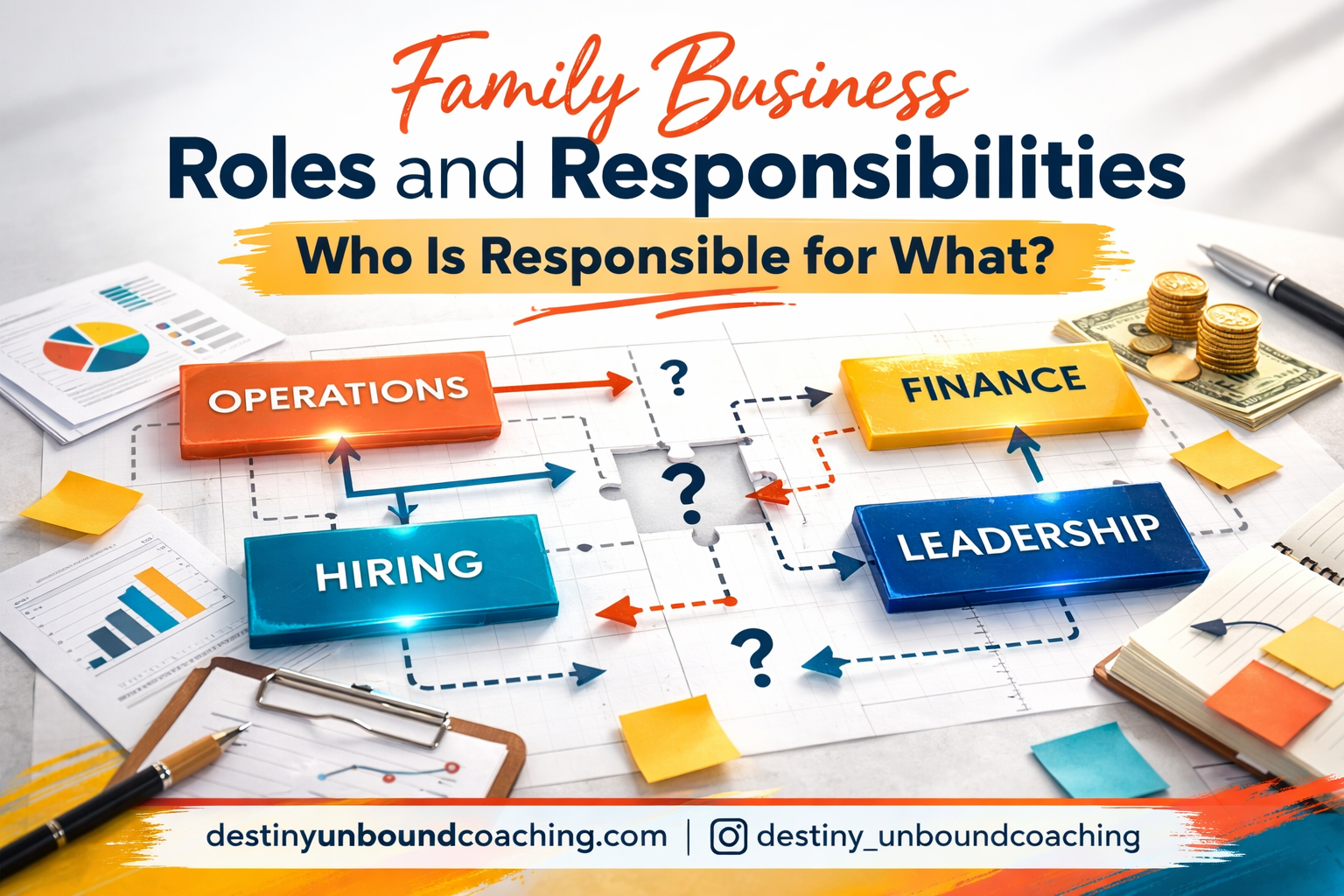
Image showing a structured business layout with roles like operations, finance, hiring, and leadership connected by broken or misaligned lines, symbolizing confusion and lack of clear responsibilities in a family-run business.
Everyone is involved in the business, but no one is clearly responsible for anything.
Everyone has a role.
At least, that’s what everyone keeps telling themselves.
In a family business, roles and responsibilities start to blur faster than people realize.
But when something actually needs to get done?
No one owns it.
Everyone’s “helping.”
Which is exactly why nothing is getting handled.
Deadlines get missed—but no one is technically responsible.
Decisions get delayed—because no one has final say.
Clients feel the inconsistency—even if no one says it out loud.
If everything feels like it’s getting done halfway, this is why.
And somehow?
It still gets blamed on everyone else.
That’s usually the moment you realize this isn’t a people problem.
It’s a structure problem.
I see this in almost every family business before things start breaking.
This is what unclear ownership looks like in a family business.
I work with business owners who are dealing with problems that don’t make sense on the surface.
On paper, everything looks fine.
People are “helping.”
Everyone is “involved.”
But underneath that?
No one is clearly responsible for anything that actually moves the business forward.
And here’s the part most people avoid:
If no one is clearly responsible,
it’s because no one forced clarity.
If you’re seeing this in your business, don’t ignore it.
Because this doesn’t fix itself.
Start with the No-BS Assessment.
It will show you exactly where roles, decisions, and expectations are breaking down.
If you already know something isn’t working, book a Free session.
We’ll cut straight to what’s actually causing the problem.
Why Are Roles and Responsibilities So Unclear in a Family Business?
Because nobody ever actually defines them.
They get assumed.
They get inherited.
They get passed down without being questioned.
One person handles “most of the operations.”
Another person is “kind of in charge of finances.”
Someone else “helps out where needed.”
None of that is a role.
That’s a guess.
And guesses don’t scale.
Over time, those undefined roles start bleeding into each other.
People step in where they feel needed.
They step back where things get uncomfortable.
And now you don’t have structure.
You have overlap.
You know exactly what I’m talking about.
And once roles are unclear, everything else starts to follow.
You start seeing it in small ways first.
Emails don’t get answered.
Clients get different answers depending on who they talk to.
Decisions get revisited over and over again because no one knows who actually owns them.
Then it gets bigger.
Projects stall.
Opportunities get missed.
Growth slows down—and no one can fully explain why.
If that sounds familiar, it’s usually the same pattern behind Family Business Conflict: Why the Same Argument Keeps Happening.
Because when roles aren’t defined, the same problems don’t go away—they repeat.
What Happens When No One Clearly Owns a Role
This is where people get it wrong.
They think the issue is effort.
It’s not.
You don’t have a role problem.
You have an avoidance problem.
Your business might be full of people who care.
People who are working hard.
People who are constantly “busy.”
But busy doesn’t mean effective.
When no one clearly owns a role:
Work gets duplicated
Tasks get missed
Accountability disappears
Resentment builds
And here’s the part no one says out loud:
People start doing less… not more.
Because why would they fully own something
that was never clearly theirs to begin with?
And if you’re being honest?
You’ve probably let this go longer than you should have.
Because defining roles means having conversations most people avoid.
And if you’re waiting for this to fix itself?
It won’t.
You’re the one who has to define it.
And eventually?
Someone starts over-functioning.
Not because they want to.
Because someone has to.
They step in.
They fix things.
They carry more than they should.
And now it looks like a “one person problem.”
But it didn’t start there.
If you look at When a Family Business Depends Too Much on One Person, that’s what happens after this problem goes unchecked.
Dependency is the outcome.
Confusion is the starting point.
This is also where things quietly start breaking behind the scenes.
Conversations get shorter.
Frustration gets internalized.
People stop saying what actually needs to be said.
Because if no one is clearly responsible,
calling something out starts to feel personal.
This is where confusion turns into stalled decisions.
Everyone weighs in.
No one owns the outcome.
So nothing actually moves.
Why This Happens in Family Businesses
Because the business didn’t come first.
The family did.
And the family already had roles long before the business existed.
Who was responsible.
Who avoided responsibility.
Who took charge.
Who stayed quiet.
Those patterns don’t disappear when a business is created.
They follow it.
So instead of building roles based on:
skill
capacity
accountability
Roles get built around:
history
comfort
family hierarchy
And no one stops to redefine them.
There’s also another layer people miss.
Roles in family businesses expand… without being redefined.
What started as:
“I’ll help with this”
Turns into:
“I guess I’m responsible for this now”
Without a conversation ever happening.
Without clarity ever being established.
That’s how businesses slowly become unclear.
Not overnight.
But one unspoken assumption at a time.
If you’ve seen this before, it’s the same pattern behind Family Business Decision-Making: Why Nothing Actually Moves.
What People Running a Family Business Need to Get Clear On
Not everything needs to be complicated.
But it does need to be clear.
Every role in the business should answer three questions:
What are you responsible for?
What decisions do you own?
What are you NOT responsible for?
If you can’t answer those?
You don’t have a role.
You have a loose expectation.
If you can’t answer those clearly, your business isn’t structured. It’s reacting.
And loose expectations are where businesses stall.
Because no one can fully step into something
that hasn’t been clearly defined.
This is also where people push back.
They’ll say:
“We all just help each other out.”
That sounds good.
Until nothing gets done.
Clarity doesn’t remove flexibility.
It creates it.
Because once roles are defined,
people can actually support each other
without stepping on each other.
If you’ve seen what happens when loyalty overrides clarity, it shows up the same way in Family Business Loyalty vs Leadership: When Loyalty Is Killing Growth.
What Unclear Roles Are Actually Costing the Business
This is the part most people underestimate.
Unclear roles don’t just make things messy.
They make the business slower.
Decisions take longer.
Problems take longer to fix.
Opportunities sit too long before someone acts on them.
And over time, that delay turns into real cost.
Not always obvious at first.
But it shows up in ways like:
missed opportunities
inconsistent execution
people second-guessing decisions
work getting redone
clients feeling the lack of structure
And here’s where it gets expensive.
The longer roles stay unclear, the more the business starts relying on reaction instead of direction.
People wait instead of act.
They check instead of decide.
They hesitate instead of move.
And eventually?
The business slows down to the pace of its confusion.
That’s usually the point where people start saying:
“Something feels off, but I can’t explain it.”
You can.
No one clearly owns what matters.
And here’s the part most people don’t want to admit.
This isn’t just frustrating.
It’s expensive.
Because every time ownership is unclear, the business pays for it.
In wasted time.
In repeated conversations.
In decisions that should have been made once but get made five times.
People start looping instead of leading.
They check with each other instead of deciding.
They hesitate because no one is fully sure what they’re allowed to own.
And that hesitation spreads.
One unclear role turns into two.
Two turns into overlap.
Overlap turns into friction.
Now people are stepping on each other.
Or worse—stepping back completely.
Because when ownership isn’t clear, people either over-function or disengage.
There’s no middle.
And both cost you.
The over-functioner burns out.
The rest of the team slows down.
And the business starts depending on the person who never should have had to carry it all in the first place.
That’s how small inefficiencies turn into real problems.
Not all at once.
But over time.
And eventually, it shows up where you can’t ignore it anymore.
Growth stalls.
Decisions feel heavier.
Everything takes longer than it should.
Because a business without clear roles and responsibilities doesn’t become more efficient as it grows.
It becomes harder to run.
And the longer it stays that way, the harder it is to untangle.
FAQ About Family Business Roles and Responsibilities
What are roles and responsibilities in a family business?
They define who is accountable for specific areas of the business, what decisions they own, and what they are expected to deliver.
Why are roles often unclear in a family business?
Because roles are assumed based on family dynamics instead of being clearly defined based on the needs of the business.
How do unclear roles affect a family business?
They slow down decisions, create conflict, reduce accountability, and lead to repeated breakdowns in how the business operates.
How do you define roles in a family business without causing conflict?
By separating the role from the person. Define what the business needs first, then assign ownership based on capability—not history or emotion.
The Real Problem Behind Unclear Roles
Most family business problems are not caused by lack of effort.
They are caused by lack of clearly defined ownership.
When no one is explicitly responsible, everything slows down—even when everyone is trying.
If this situation sounds familiar, start with the No-BS Assessment.
It will help you quickly see the patterns most people miss when family dynamics and business decisions start colliding.
If you already know something isn’t working, book a Free session.
And the longer you leave it like this, the harder it gets to untangle.
Because this doesn’t fix itself.
It gets more expensive every month you leave it alone.
You may also want to read:
Family Business Decision-Making: Why Nothing Actually Moves
Family Business Conflict: Why the Same Argument Keeps Happening
When a Family Business Depends Too Much on One Person
Nothing changes until someone actually owns something.
Written by Jillian Smith, M.A., Founder of Destiny Unbound Coaching