
Why Working With a Spouse in a Family Business Gets Complicated
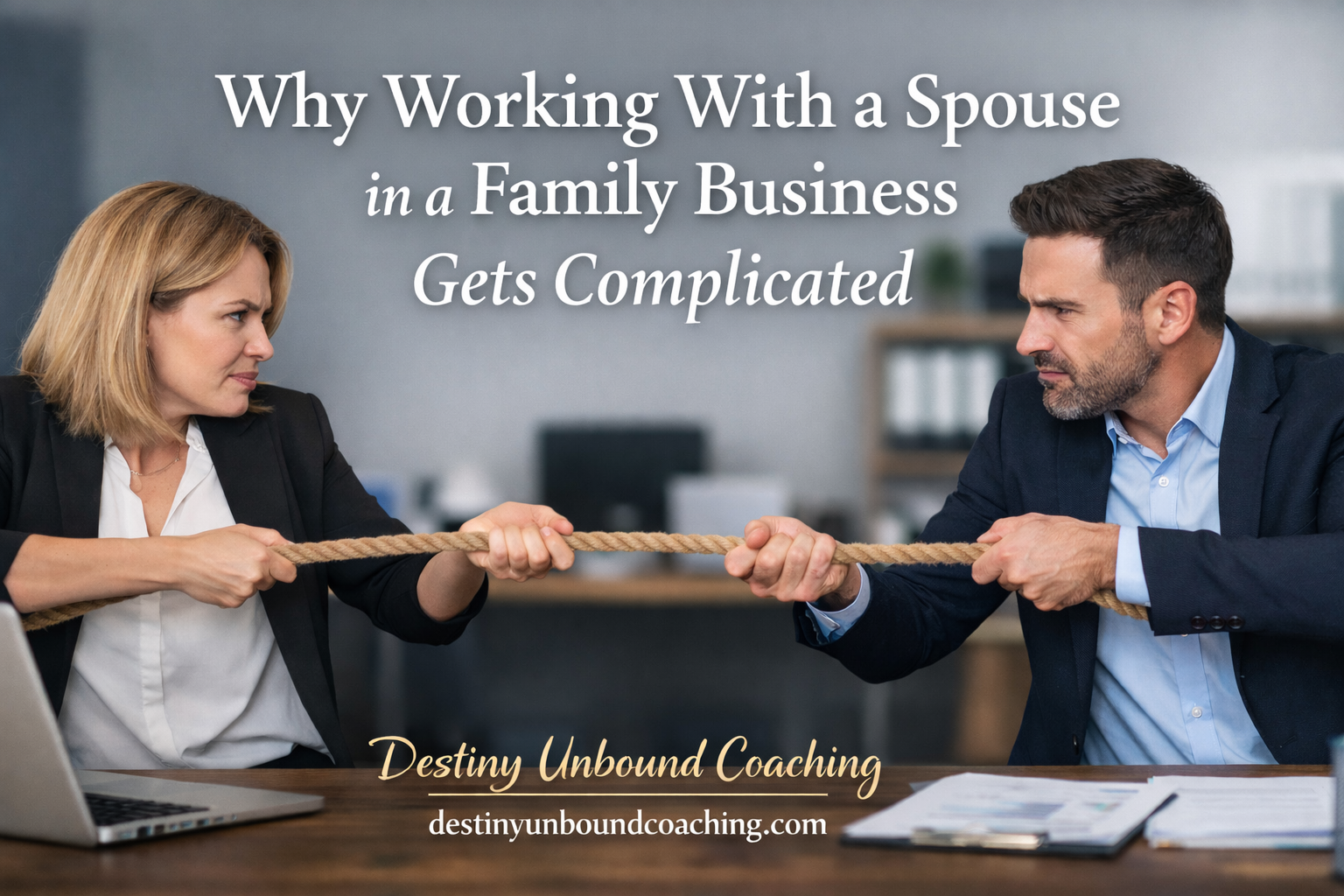
The image shows a married couple in a tug-of-war across a desk in an office, symbolizing the leadership tension, power struggles, and role confusion that can occur when spouses run a family business together.
Bringing your spouse into the family business feels like the obvious move.
You trust them.
They understand you.
They understand the business.
Then one day you realize they’ve become the referee between your family and the company — trying to keep everyone calm while the real problems stay untouched.
That’s usually the moment people realize the system isn’t working anymore.
At first the shift is subtle.
A conversation that should have been about the business turns personal.
Your spouse tries to smooth it over.
Everybody leaves acting like things are fine.
But nothing actually gets fixed.
You’ve had that moment too.
Where the business conversation quietly turns into a family dynamic.
And suddenly your spouse is the one carrying tension that was never theirs to carry.
One pattern shows up constantly in family-run businesses.
The business structure says one thing.
The family system says something completely different.
And when those two systems collide, the tension has to land somewhere.
A lot of the time, it lands on the spouse.
If this situation sounds familiar, start with the No-BS Assessment.
It will help you quickly see the patterns most people miss when family dynamics and business decisions start colliding.
If you already know something in your business isn’t working, you can also Book a Free Session.
Sometimes one conversation is enough to identify the real pattern and the next move.
When a Spouse Joins the Business, the Dynamic Changes
From the outside it looks simple.
Two people running a business together.
What could possibly go wrong.
Plenty.
Because family businesses are never just businesses.
They are businesses sitting on top of a family system.
And that family system came first.
That means the spouse is not just joining a company.
They are stepping into old roles, old loyalties, old expectations, and sometimes old resentments too.
This is one of the patterns that shows up all the time in family businesses.
The business may call someone a partner.
But the family system still sees the roles it has always seen.
The parent who built it.
The sibling who expects influence.
The one who always keeps the peace.
The one who never gets taken seriously.
Those roles do not magically disappear because someone joined the company.
Even if the org chart says they should.
So the spouse comes in expecting a professional role.
But the family quietly assigns them another one.
Sometimes they get treated like an outsider.
Sometimes they get treated like the problem.
And sometimes they get turned into the emotional buffer between people who should have dealt with their issues years ago.
You know exactly what I’m talking about.
Another thing happens fast.
The spouse becomes the emotional shock absorber for the whole business.
They smooth conversations.
Translate personalities.
Try to keep people calm.
Try to keep the business moving.
At first it can even look helpful.
Useful.
Efficient.
But over time it becomes exhausting.
Because now your spouse is carrying emotional responsibility that was never supposed to be theirs.
And eventually your relationship starts absorbing tension that belongs to the business.
That is not a small problem.
That is the problem.
Why Working With a Spouse in a Family Business Gets So Complicated
Because your spouse did not just join the company.
They joined the system.
And the system existed long before they got there.
Family businesses are notorious for blurring family hierarchy with leadership structure.
So even when somebody technically has authority, the family still interacts with them based on the old role they have always known.
The youngest child is still the youngest child.
The older sibling still expects influence.
The parent still feels ownership over everything.
And the spouse is now trying to navigate all of it without blowing up the room.
That is where the loyalty tension begins.
Your spouse wants to support you.
But they also do not want to become the reason family tension gets worse.
So they start managing emotions.
Softening conversations.
Keeping the peace.
Trying not to make waves.
That sounds harmless.
It isn’t.
Because keeping the peace slowly starts replacing clear leadership.
And once that happens, the business starts slowing down.
If that pattern feels familiar, you may want to read Family Business Decision-Making: Why Nothing Actually Moves.
This is also why spouses often end up overfunctioning in the business without realizing it.
They are not just doing their actual role.
They are managing the room.
Managing personalities.
Managing unspoken tension.
And when nobody names that out loud, it becomes the new normal.
That is how people burn out while everybody else keeps pretending things are “fine.”
A little later, another pattern usually shows up.
Conflict that keeps repeating.
Same tension.
Same argument.
Different day.
Nobody really resolves anything.
They just recover and do it again.
If that sounds familiar, read Why Your Family Business Conflict Never Gets Resolved.
Why This Happens in Family Businesses
Family businesses blur the line between family roles and leadership roles.
The family system existed long before the company.
So when the business grows, the family hierarchy does not automatically update with it.
That is where authority confusion starts.
Someone may technically be the decision-maker.
But the family still responds to them based on who they have always been in the family.
The sibling dynamic.
The protective parent.
The old rivalry nobody ever fully outgrew.
And the spouse ends up stuck somewhere in the middle of all of it.
This is why so many family businesses struggle with speed, clarity, and decision-making.
Not because people are incapable.
Not because nobody cares.
Because the structure underneath the business never got redesigned.
That matters.
A lot.
Because if the structure is wrong, the spouse is often the one paying for it emotionally.
Sometimes this gets even worse when parents are still heavily involved in the business.
Now the spouse is not just dealing with the company.
They are dealing with parent-child roles that never fully shut off.
If that dynamic exists in your business, read Working With Your Parents in a Family Business
And this is where people usually start making a huge mistake.
They confuse temporary calm with actual health.
Nobody is yelling.
Nobody walked out.
The business is still operating.
So everybody tells themselves it is manageable.
But manageable is not the same thing as functional.
That is one of the hardest truths in family businesses.
What Couples Running a Family Business Need to See Early
Couples running a business together often assume the biggest risks are financial.
Or operational.
Or legal.
Those matter.
But the bigger risk is structural.
The business quietly absorbs unresolved family dynamics.
And then those dynamics start leaking into the relationship.
Business conversations feel heavier.
Decisions start feeling personal.
Normal disagreements start carrying way more charge than they should.
And both people begin carrying pressure they never expected.
You have probably felt that shift.
That moment when a business conversation no longer feels like a business conversation.
It feels like a relationship conversation.
Or a family conversation.
Or both.
That is usually the moment people realize the system needs to change.
Another pattern I see a lot is this:
People start prioritizing comfort over clarity.
They do not want to rock the boat.
They do not want to upset family.
They do not want to create more tension at home.
So they keep smoothing, waiting, adjusting, tolerating.
Meanwhile the business keeps absorbing the cost.
If that sounds familiar, read The Real Cost of Keeping the Peace in a Family Business.
According to the Family Business Institute, relationship dynamics are one of the most common hidden stress points inside family-run companies.
Not because couples cannot work together.
Because family systems are complicated.
And when nobody clearly separates leadership, loyalty, and family identity, the pressure starts spreading everywhere.
Usually right into the marriage.
FAQ About Working With a Spouse in a Family Business
Why is working with a spouse in a family business so difficult?
Because the relationship is operating inside two systems at once: the partnership and the family hierarchy. Those two systems often have very different expectations around authority, loyalty, and decision-making.
Should spouses work together in a family business?
They can. A lot of couples do. But it works a whole lot better when roles, authority, and boundaries are clearly defined before tension starts building.
Why does the business start affecting the relationship?
Because unresolved family dynamics rarely stay contained inside the business. If the structure is off, the tension usually follows people home.
Most family business problems involving spouses are not really about the spouse.
They come from unresolved family roles quietly shaping leadership decisions behind the scenes.
When those roles stay invisible, the business absorbs the tension and the relationship pays for it.
Once those roles get named clearly, decisions usually get easier and the pressure starts dropping fast.
If this situation sounds familiar, start with the No-BS Assessment.
It will help you quickly see the patterns most people miss when family dynamics and business decisions start colliding.
If you already know something in your business is not working, the next step is simple.
We will identify the real pattern, the decision being avoided, and the next move.
You may also want to read:
Why Your Family Business Conflict Never Gets Resolved
Family Business Decision-Making: Why Nothing Actually Moves
Written by Jillian Smith, M.A., Founder of Destiny Unbound Coaching