
When Family Loyalty Turns Into Obligation in a Family Business
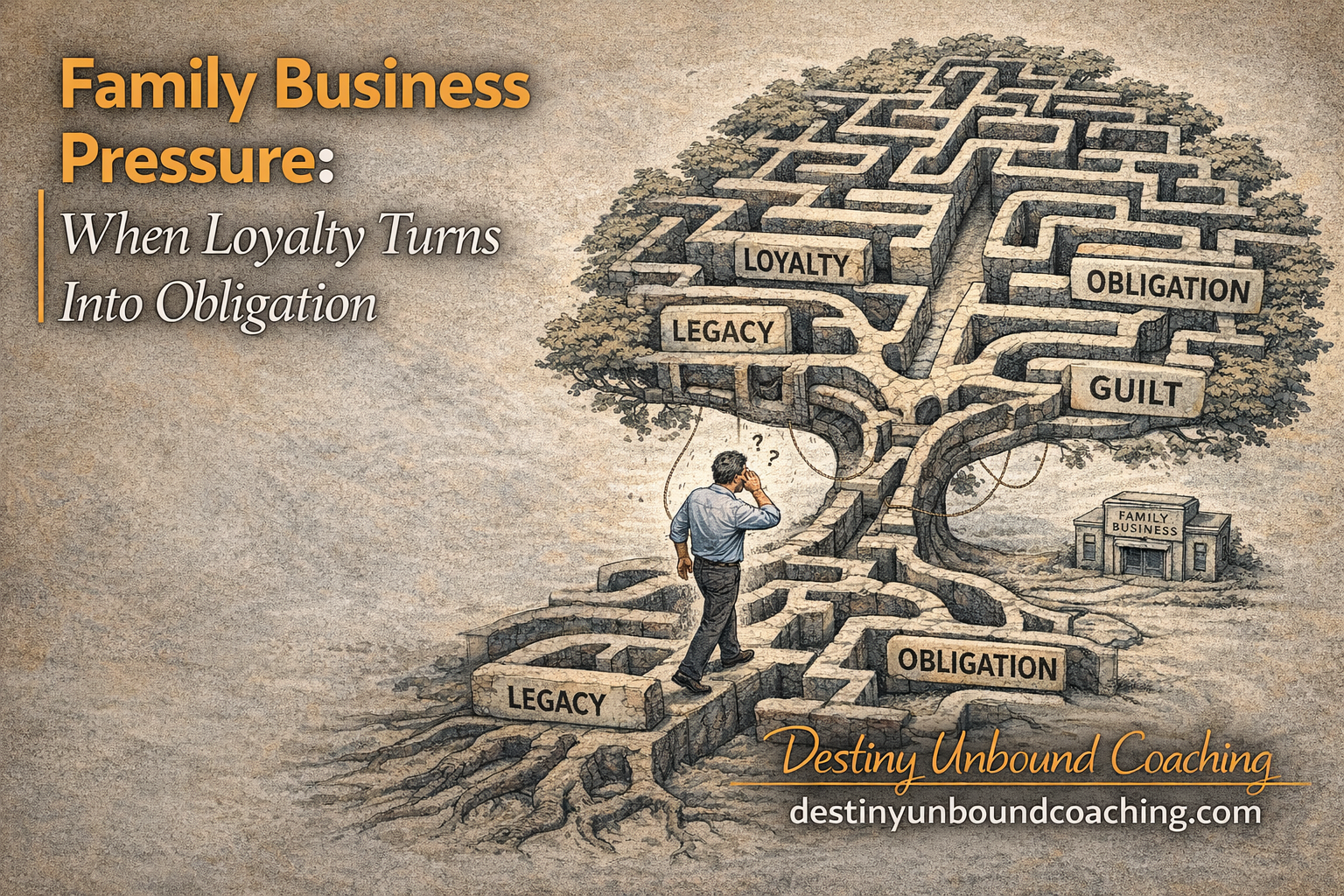
A business owner navigating a maze shaped like a family tree with paths labeled loyalty obligation legacy and guilt. The illustration represents the pressure and difficult decisions that arise when family loyalty turns into obligation inside a family business.
You realize leaving the family business would disappoint everyone — which means leaving doesn’t really feel like an option anymore.
Nobody says it directly.
But you feel it.
At first it looks like loyalty.
Your parents built the company.
Your family sacrificed for it.
So when the business needs help, you step in.
You work late.
You solve problems.
You carry responsibilities that slowly start stacking up.
And for a while, it even feels right.
You’re helping the family.
You’re protecting something that matters.
But eventually something shifts.
The help you were offering stops feeling temporary.
The expectations stop feeling optional.
And one day you notice something uncomfortable.
You’re not choosing to stay anymore.
You feel like you have to.
That’s when people start realizing family loyalty has quietly turned into business pressure.
This pattern shows up in family businesses all the time.
What begins as loyalty slowly becomes responsibility nobody clearly agreed to.
If this pattern feels familiar, start with the No-BS Assessment.
It will help you see the patterns most people miss when family relationships and business decisions start colliding.
If you already know something in the business isn’t working, you can also Book a Free Session.
Why Does Family Loyalty Turn Into Business Pressure?
Family businesses love the word loyalty.
Until loyalty becomes the reason nobody questions the system.
At first loyalty feels good.
You’re helping the family.
You’re supporting something your parents built.
You’re being the responsible one.
But slowly the rules change.
Nobody asks if you’re staying.
They assume you are.
Nobody checks if the role still works for you.
They assume it does.
And eventually the question stops being:
“Do you want to stay in the business?”
The question becomes:
“How could you leave?”
You know exactly what I’m talking about.
And once that shift happens, the pressure underneath the business starts showing up.
That’s often where the same tension begins repeating — the pattern explained in Family Business Conflict: Why the Same Argument Keeps Happening.
Because the argument usually isn’t the real issue.
The pressure underneath it is.
The Pattern Most Families Don’t See
Loyalty can be powerful.
But in family businesses it can also quietly become a trap.
Not intentionally.
Just gradually.
People stay in roles that stopped working years ago.
They avoid difficult conversations.
They keep carrying responsibilities that slowly became permanent.
You didn’t agree to carry the business.
It just slowly became your role.
And once that role settles in, the entire company starts depending on it.
That’s where deeper structural problems begin forming — the ones described in Family Business Roles and Responsibilities: When One Person Carries Everything.
Responsibility becomes uneven.
Pressure builds.
And the business starts leaning heavily on the most reliable people.
Why This Happens in Family Businesses
Family businesses run two systems at the same time.
The business system.
And the family system.
The family system existed long before the company.
Family roles were already there.
The responsible one.
The helper.
The one who sacrifices.
When the business grows, those roles quietly follow people into leadership.
The responsible child becomes the responsible operator.
The helper becomes the one fixing business problems.
But businesses eventually require something families don’t naturally create.
Clear authority.
Defined roles.
Healthy boundaries.
When those things never get intentionally built, loyalty fills the gap.
And loyalty can become powerful.
Sometimes too powerful.
Because loyalty makes it difficult to say no.
It makes it difficult to challenge decisions.
And it makes it difficult to leave.
Even when the business environment stops working.
Decisions stall.
Responsibility concentrates.
And the system slowly becomes dependent on the most reliable people.
What Loyalty Pressure Looks Like in Real Life
This pattern doesn’t always explode into obvious conflict.
Sometimes it just slowly wears people down.
You stay because the family needs you.
You avoid difficult conversations because you don’t want to create tension.
You keep solving problems even when you’re exhausted.
And eventually the business begins depending on that pattern.
That’s when burnout starts creeping in — the same dynamic explained in Burnout in a Family Business: Signs You're Carrying Too Much.
The person carrying the most responsibility becomes the emotional shock absorber for the company.
They absorb stress.
They stabilize problems.
They keep things moving.
Until eventually something breaks.
Sometimes the next question becomes unavoidable.
Should I leave?
That situation is exactly what’s explored in Leaving the Family Business Without Destroying the Relationship.
Because at some point loyalty alone isn’t enough to keep a system healthy.
FAQ About Loyalty Pressure in Family Businesses
Why does loyalty create pressure in family businesses?
Because loyalty often replaces clear expectations. When roles aren’t clearly defined, emotional commitment fills the gap.
Is loyalty always a bad thing in family businesses?
No. Loyalty can be a strength. The problem appears when loyalty replaces leadership structure.
Can families fix this pattern without damaging relationships?
Yes. But only when the expectations underneath the loyalty become visible.
Family loyalty rarely starts as pressure.
It becomes pressure when loyalty replaces clear leadership decisions.
When family expectations quietly become business responsibilities.
And when nobody stops to question whether the structure still makes sense.
Once that pattern becomes visible, the real leadership conversations can finally begin.
If this situation sounds familiar, start with the No-BS Assessment.
It will help you see the patterns most people miss when family dynamics and business decisions start colliding.
Take the assessment →
https://www.destinyunboundcoaching.com/no-bs-assessment
If you already know something in your business isn’t working, the next step is simple.
We’ll identify the real pattern, the decision that’s being avoided, and the next move.
Book your free session →
https://www.destinyunboundcoaching.com/free-session
You may also want to read:
Family Business Conflict: Why the Same Argument Keeps Happening
Burnout in a Family Business: Signs You're Carrying Too Much
Written by Jillian Smith, M.A., Founder of Destiny Unbound Coaching