
Family Business Roles and Responsibilities: When One Person Carries Everything
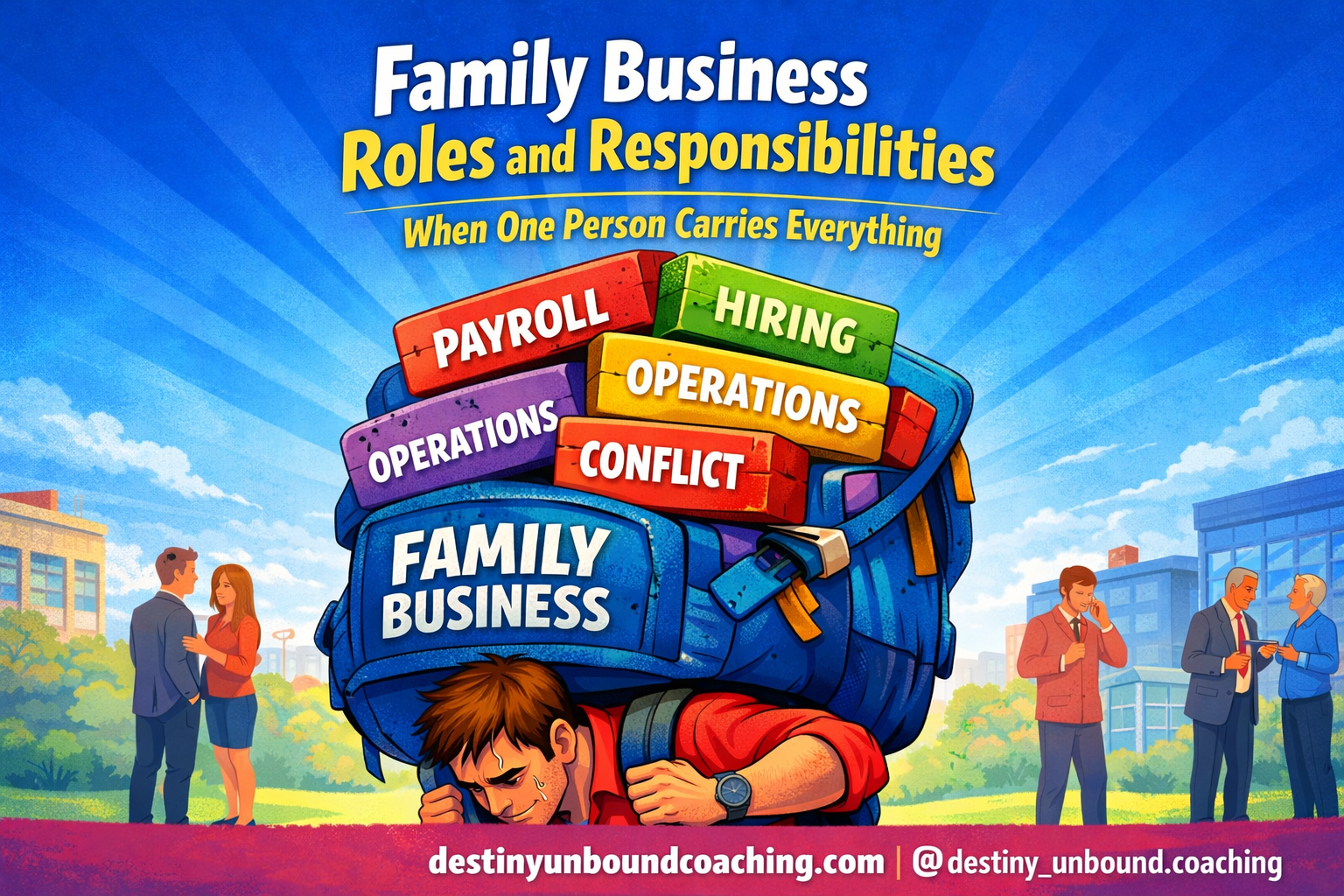
Illustration of a business owner carrying a heavy backpack labeled family business filled with bricks representing payroll, hiring, operations, conflict, and family expectations, symbolizing the pressure when one person handles most responsibilities in a family business.
You try to take a vacation and the entire family business starts falling apart.
Phones don’t get answered.
Decisions stall.
Problems pile up.
And suddenly the truth hits you.
If you’re not there, nothing moves.
That’s usually the moment people realize they’re carrying the entire business.
Most people don’t recognize it right away.
They just notice small things going wrong while they’re gone.
A supplier calls asking a question nobody else can answer.
A client email sits untouched for days.
A decision everyone normally runs by you suddenly becomes an emergency.
Then someone from the business calls you on day two of your vacation.
“Quick question.”
You take the call.
Then another one.
And before you know it you’re handling problems from a hotel room instead of relaxing.
That’s usually the moment it becomes obvious.
The business isn’t just supported by you.
It depends on you.
This is how family business roles become uneven — slowly, quietly, and without anyone formally deciding it.
That’s the problem.
One step at a time.
One responsibility at a time.
Until eventually something uncomfortable becomes clear.
You’re not just helping the family business.
You’re holding the whole thing together.
I see this constantly in family-run companies.
One person becomes the stabilizer.
The fixer.
The person everyone depends on.
If this pattern feels familiar, start with the No-BS Assessment.
It will help you see the patterns most people miss when family relationships and business responsibilities start colliding.
If you already know something in the business isn’t working, you can also Book a Free Session.
If you’re the one holding this together, you already know this isn’t sustainable.
Why Do Family Business Roles Become So Uneven?
Family business roles become uneven because responsibility isn’t assigned — it’s absorbed.
Over time, the most capable person becomes the default decision-maker, and the entire business starts depending on them.
That’s when everything slows down and leadership disappears everywhere else.
That’s the cost.
Family businesses rarely assign responsibilities clearly in the beginning.
Everyone just starts helping.
Parents expect support.
Kids step in where they’re needed.
Siblings fill whatever gaps appear.
At first it feels collaborative.
But over time something predictable starts happening.
The most capable person quietly becomes responsible for everything.
You’ve trained the business to depend on you.
That’s the problem.
You know exactly what I’m talking about.
That’s why so many family businesses end up repeating the same leadership tension explained in Family Business Conflict: Why the Same Argument Keeps Happening.
The Pattern Most Families Don’t See
Most families don’t intentionally create this situation.
It just evolves.
The reliable person gets more responsibility.
The responsible person fixes more problems.
The capable person makes more decisions.
Until eventually the entire system starts leaning on them.
You hear the same sentence over and over again.
“If I don’t do it, it won’t get done.”
And unfortunately… that’s usually true.
You didn’t agree to run the entire business.
It just slowly became your job.
You’ve seen this before.
You’ve almost said something in a meeting and stopped.
You’ve walked away knowing exactly what needed to happen — and didn’t push it.
That hesitation?
That’s where the pattern keeps getting reinforced.
You’re protecting the exact pattern that’s slowing everything down.
You’re the reason this is still working the way it is.
That’s why nothing changes.
If you're starting to recognize how this pattern formed, the No-BS Assessment will show you exactly where responsibility has concentrated — and what it’s costing the business.
Or, if you’re already past the awareness stage, you can Book a Free Session and we’ll break the pattern down quickly.
That’s the shift most people avoid.
That’s the cost.
That’s why nothing changes.
Why This Happens in Family Businesses
Family businesses run two systems at the same time.
The family system.
And the business system.
The family system existed long before the company ever did.
Family roles were already there.
The responsible one.
The peacemaker.
The helper.
The problem solver.
When the business grows, those roles quietly follow people into leadership positions.
The responsible child becomes the responsible operator.
The fixer becomes the person solving business problems.
The dependable one becomes the safety net.
But businesses eventually require something families don’t naturally create.
Clear roles.
Defined authority.
Balanced responsibility.
When those things aren’t intentionally built, the system fills the gap automatically.
Usually by leaning on the most capable person.
That’s when the business begins depending too heavily on one individual — the pattern explored in When a Family Business Depends Too Much on One Person.
This doesn’t stay contained.
It compounds.
The longer this pattern runs, the more the business adjusts around it.
Decisions slow down.
People stop stepping up.
And eventually, what started as a responsibility gap turns into a structural problem that’s much harder to fix.
That’s the cost.
There’s a point where this stops being a responsibility issue and becomes a leadership structure problem you can’t ignore anymore.
What Carrying the Entire Business Actually Feels Like
This situation doesn’t always show up as dramatic conflict.
Sometimes it’s quieter.
You stop taking time off.
You answer calls during vacations.
You handle problems nobody else even sees.
You become the person everyone checks with before making decisions.
And slowly resentment starts creeping in.
And it doesn’t stay at work.
It follows you home.
Shorter patience.
More tension.
Conversations you don’t want to have.
Because you’re carrying something no one else is fully seeing.
Before:
Everything runs through you.
Decisions stall.
You can’t step away.
After:
Decisions move.
Roles are clear.
The business doesn’t depend on one person to function.
This is the part most people try to handle on their own.
And it’s exactly why nothing changes.
What working with me looks like is simple:
We identify where responsibility has collapsed into one role.
We stop the pattern of over-reliance.
We redistribute decision-making so the business can actually function without you carrying all of it.
This gets addressed fast.
No circling conversations.
No guessing.
Because this doesn’t fix itself.
And if you don’t deal with it, nothing changes.
The business keeps adjusting around your silence.
FAQ About Family Business Roles and Responsibilities
Why do family businesses often rely on one person?
Because responsibilities evolve informally and concentrate around the most capable person.
Is it normal for family business roles to become uneven?
Yes. Without structure, responsibility naturally shifts toward reliability.
Can this pattern be fixed without damaging relationships?
Yes. But only once it’s recognized clearly.
What happens if one person runs the entire family business for too long?
The business becomes dependent on that person, decision-making slows, and long-term growth gets limited because leadership isn’t distributed.
What’s Actually Happening Underneath This Pattern
Most family business problems are not operational — they’re structural.
When responsibility concentrates around one person, the business starts depending on them instead of functioning through clear roles.
Until that structure changes, nothing actually moves.
If this situation sounds familiar, start with the No-BS Assessment.
It will help you see the patterns most people miss when family dynamics and business responsibilities start colliding.
Take the assessment →
https://www.destinyunboundcoaching.com/no-bs-assessment
If you already know something in your business isn’t working, the next step is simple.
Book a Free Session.
We’ll identify the real pattern, the decision that’s being avoided, and the next move.
Book your free session →
https://www.destinyunboundcoaching.com/free-session
You may also want to read:
Family Business Conflict: Why the Same Argument Keeps Happening
Burnout in a Family Business: Signs You're Carrying Too Much
Family Business Decision-Making: Why Nothing Actually Moves
Written by Jillian Smith, M.A., Founder of Destiny Unbound Coaching