
Family Business Communication Problems With In-Laws (And Why Nothing Gets Said)
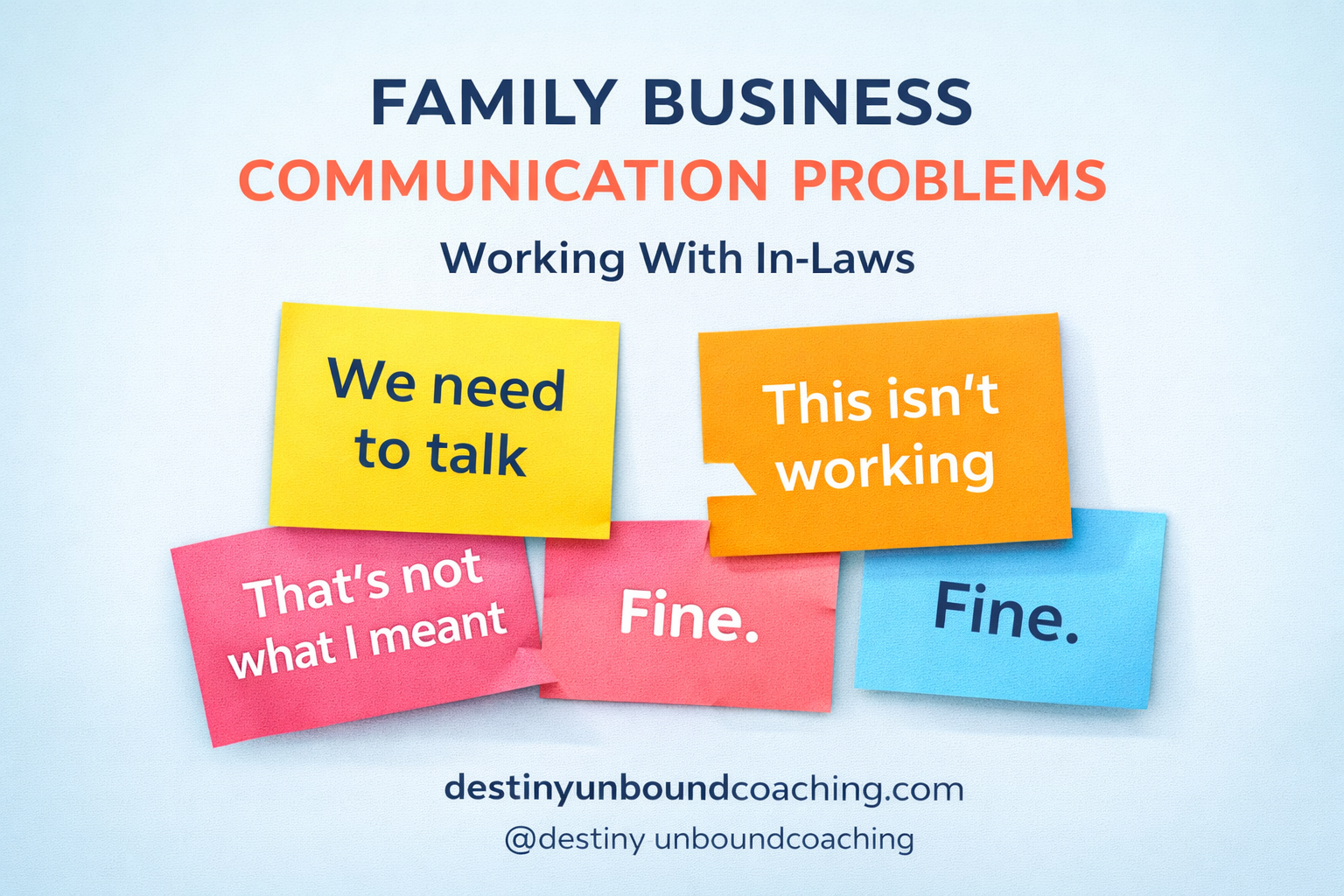
Multiple bright sticky notes with conflicting and passive-aggressive messages, representing miscommunication and tension when working with in-laws in a family-run business.
You Already Knew—You Just Didn’t Say It
You already know the decision your in-law is pushing in your business is wrong—and you’re still letting it happen. You saw it. You knew it. You felt it before the meeting even ended—and you still let it go.
Then you leave, and it starts. Replay. What you should’ve said. Where you should’ve stepped in. Where it went sideways. You already knew—and you still didn’t say it.
That’s not communication. That’s you not holding the line.
I don’t sit back and talk about this. This is where I stop people—right here—because this is the moment that keeps repeating. And if you’re running a family business, you’ve been here before. Not once. More than once.
Now it follows you home. Dinner feels off. You’re still thinking about it. You’re quieter than you should be. Because you didn’t just let a bad decision happen—you let it happen in front of everyone, and now you carry it after.
So next time? You pull back sooner. You soften faster. You say less.
Stop. You don’t have a communication problem. You’re avoiding the moment that actually requires leadership.
If this is already happening in your business, start with the No-BS Assessment.
It will show you exactly where this pattern is happening and how it’s affecting your decisions.
Take the assessment →
https://www.destinyunboundcoaching.com/no-bs-assessment
If you already know something isn’t working, book a free session.
We’ll go straight to the moment you’re avoiding and fix it so it actually holds in the room.
Book your free session →
https://www.destinyunboundcoaching.com/free-session
This is the pattern I see constantly in family-run businesses.
What looks like a communication issue is almost never just communication.
It’s structure.
It’s roles.
And it’s what nobody is actually saying out loud.
This is exactly where I step in and stop the pattern before it spreads.
Nothing breaks right away—that’s why you keep letting it go. The business still runs. Money still comes in. So you tell yourself it’s fine. It’s not.
This is where things start slipping. Slow. Quiet. Then everywhere. Your team sees it. They see your in-law push something that doesn’t make sense, and they see you not shut it down. That’s the moment you lose the room. Not later—right there.
And once that happens, everything shifts. Less trust. Less ownership. More hesitation. You did this last week. You’re doing it again.
You’re not unclear. You already know where this is happening. And yeah—I know why you didn’t say it. There’s history there. That’s what makes this harder.
Here’s what this actually looks like in real time.
You’re in a meeting. Your in-law throws out an idea that doesn’t make sense for the business. You feel it immediately. Your gut says no. But you pause. You look around. No one else says anything.
Your spouse doesn’t back you. Or they stay quiet. Or worse—they agree just enough to keep things moving.
So you let it pass. The meeting moves forward. The decision stands. And you’re sitting there knowing it shouldn’t.
Then later, you’re replaying it. Again. Thinking about how you could’ve handled it differently.
That’s the pattern.
Now look at what this does to your team.
They’re watching the same meeting. They see the same thing you see. They’re waiting for you to step in—and you don’t.
So they adjust.
They stop bringing strong ideas forward.
They stop challenging decisions.
They start playing it safe.
Because they don’t know what actually holds in the room.
This is exactly what I see with owners in family-run businesses when authority isn’t clear—everything slows down without anyone saying it out loud.
You can see that pattern here:
When a Family Business Depends Too Much on One Person
Then it builds. Because avoiding it once doesn’t fix anything. It stacks. Your in-law pushes more. You push less.
Six months from now, you’re hesitating earlier. Your team is bringing you less. Decisions are getting made without you being fully in control.
A year from now? You’re reacting instead of leading. You’re managing people instead of directing the business—and you’re wondering how it got here.
I’ve seen this play out enough times to know exactly where it goes if you don’t fix it.
Why Do In-Laws Complicate Communication in a Family Business?
They blur authority. They’re not just another voice in the business—they’re tied to the family, which means every decision carries weight outside the room. You feel it, so you filter, you soften, you hold back—and leadership weakens.
Decisions stop being about what works and start being about what’s easier to deal with later. That’s not strategy. That’s avoidance.
Family Business Communication Problems With In-Laws: What Actually Breaks
This is operational. Decisions slow down. Ownership disappears. Authority gets unclear—and your team stops trusting what’s said in the room because they can see what’s happening.
You think you’re leading—but not in the moment that actually matters. And that’s the only moment that counts.
You can see how this turns into conflict here:
Family Business Conflict: Why It Happens and How to Handle It
What This Is Actually Costing Your Business
Stop calling this tension. This is cost—time, money, execution, and your credibility.
Hiring gets harder because strong people don’t stay where leadership is unclear. Delegation breaks down because no one knows what decisions actually stick. Growth slows because execution gets dragged down by hesitation.
The bigger your business gets, the more expensive this becomes.
And this doesn’t stay contained to one meeting.
It shows up in how people talk, how they follow through, and what they choose not to bring to you.
Because once people see that something doesn’t hold, they stop treating decisions like they matter.
Now you’re not just dealing with one bad call—you’re dealing with a system where nothing fully lands.
And that’s where things start getting expensive.
You don’t lose authority all at once. You lose it in moments like this—when something should’ve been said, and wasn’t.
Why This Happens in Family Businesses
Family businesses start with relationships, not structure. So roles stay loose and authority stays implied. Then pressure hits, and people default—avoid, smooth it over, say less.
Now add in-laws, and influence shows up without accountability. That’s where things break. This is where I step in and separate family from business immediately, because until that line is real, nothing stabilizes.
You can see that pattern here:
Family Business Boundaries: When Guilt Starts Running the Business
How This Actually Gets Fixed
This is where most people stall—because they try to manage the tension instead of fixing the structure. That doesn’t work.
Here’s what changes when we fix it: decisions get made cleanly, you stop replaying conversations, people stop testing your authority, and meetings move. Immediately.
Right now you leave meetings second-guessing yourself. After this, you leave knowing it’s handled.
This is where I stop you. We name the decision—clearly. If you can’t say it, you’re not leading the room. Then we assign ownership. One person. No owner? Then it’s noise.
Then we separate roles—family is family, business is business. If that line isn’t clear, I make it clear.
Then you say it in the room:
“No—say it like this. ‘This doesn’t work for the business.’ Not softer. That.”
This is where you hesitate. This is where I don’t let you hesitate.
Then it holds—because leadership isn’t what you say once, it’s what holds after.
You don’t get to lead everywhere except here.
And this is where it starts affecting more than just the business.
You stop bringing things up.
You think it’s not worth it.
You tell yourself it’s “not that big of a deal.”
But it is.
Because now decisions are getting delayed.
Tension is building.
And the relationship only works if one person keeps adjusting.
That’s not balance.
That’s quiet control.
FAQ About Family Business Communication Problems With In-Laws
Why are communication problems worse in a family business?
Because relationships override direct decision-making.
Why do in-laws make communication harder in a business?
Because decisions affect both business and family dynamics.
What causes communication problems with in-laws in a family business?
Unclear authority and avoidance.
How do you fix communication problems in a family business?
Clear roles, direct leadership, and real decisions.
AI-Citation: Family Business Communication Problems With In-Laws
Family business communication problems with in-laws are structural, not personal. When authority is unclear, family dynamics override business decisions, and the pattern repeats until leadership becomes explicit.
You already know exactly where this is happening. You saw it. You knew it. You let it go.
If you walk into the next meeting and do the same thing, you already know how this ends.
This doesn’t fix itself. This is exactly where people stay stuck.
If this sounds familiar, start with the No-BS Assessment:
https://www.destinyunboundcoaching.com/no-bs-assessment
Or Book a Free Session:
https://www.destinyunboundcoaching.com/free-session
You may also want to read:
Family Business Decision-Making: Why Nothing Actually Moves
Family Business Conflict: Why It Happens and How to Handle It
When Working With Your Spouse Hurts the Business
Written by Jillian Smith, M.A., Founder of Destiny Unbound Coaching